Your association | PPC97 November 2019
In this article BPCA’s Communications Officer, Kat Shaw, spoke to Phillippa Hawkins from Falconry Services Bird and Pest Control about carrying out pest control in stadiums with her feathered colleagues.
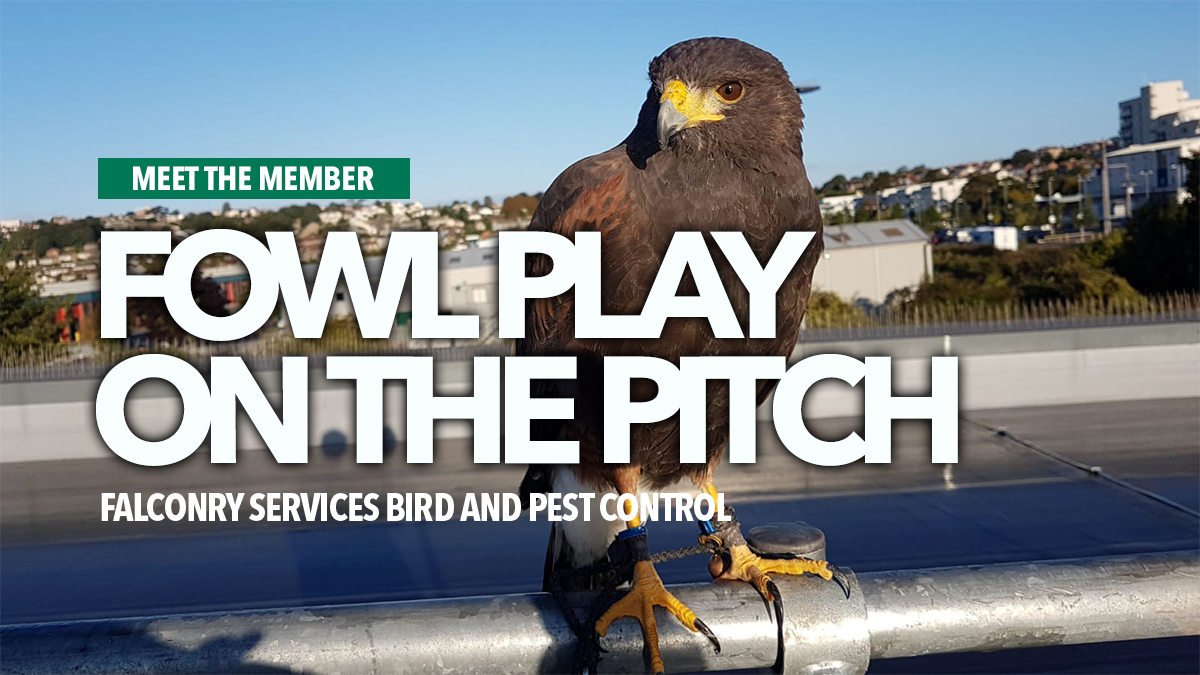
Football stadiums are the perfect place for pests to set up shop. Plenty of food scraps to feast on, lots of harbourage and easy access.
Birds, in particular, love that stadium real estate for roosting.
Many are in built up areas, which means birds can use them as an anchor point from which to scavenge nearby estates or towns.
Arguably the most effective way to combat problem birds in a stadium environment is by using birds of prey.
A psychological stand-off
Phillippa has worked in pest management for 20 years, having set up Falconry Services with her husband in 1999.
“I sort of got into falconry a bit by accident,” says Phillippa. “I went to an agriculture show and someone was showing Harris’s hawks and I loved it.
“I decided to learn how to fly them myself and I got hooked. After 23 years of flying hawks, I never get bored of them. It’s such a buzz.”
Falconry Services has been carrying out pest control contracts in stadiums for a number of years.
“We’ve had all sorts: mink in rivers by the stadium, bee swarms on turnstile gates two hours before kick-off.
“The French rugby team are notorious for releasing live cockerels onto the pitch, so we’ve been cheered on by thousands of rugby fans at half-time while we chase the birds with a net.”
One of the contracts Phillippa carries out is for the Principality Stadium in Cardiff.
“It has a retractable roof which is open 90% of the time and is like a giant Meccano set, so realistically you can’t proof that area,” says Phillippa.
“The easiest way to go up there is with a bird.”
You really need to put the hours in. If the pest bird thinks the hawk is just passing through, they’ll sit tight and ride it out.
Phillippa Hawkins
There’s a public image issue to bear in mind when considering the pest management methods we choose to implement. Of the options available, falconry is one of the least controversial and most natural methods of control.
The birds of prey work as a deterrent and although not guaranteed (after all, nature gonna nature) they don’t generally attack the pest birds.
“It’s more of a psychological stand-off to claim the territory,” says Phillippa. “Falconry works by triggering the survival instincts of the pest bird.”
This is why a falconer needs to be on site, working in the hotspots, at least four to six days a week in the beginning (depending on how established a colony of birds is).
She explains, “The pigeons needs to see the hawk as often as possible, exercising and flying around. It makes them unsettled and they’ll be unwilling to stay.”
She continued, “You really need to put the hours in. If the pest bird thinks the hawk is just passing through, they’ll sit tight and ride it out.
“But if the hawk is there regularly and you can convince the pest that this is the hawk’s territory, then they won’t hang around and nest there.”
Nature at its best

Hiring a falconer to help control pest birds is not uncommon and is quite a spectacle to watch in action.
The falconer will try and get as close as possible to the roosting site and bring the bird over the top of them.
Birds instinctively stay high, to keep the vantage point, and trained hawks will stay above the falconer, moving where they’re directed.
It’s important that you use the right type of bird on a site. For example, Phillippa flies Harris’s hawks on stadium jobs, particularly female hawks.
“They are uniquely suited to doing stadium jobs because they’re a gregarious, laid back, social bird in the wild,” she says. “That means they cope with the busy stadium environment really well.
“In the wild, they’re designed to work in crowded woodland, so flying among the metal beams of a stadium roof is no problem: their close wingspan means they can cope with that.”
“In short, you can’t beat nature at its best,” says Phillippa. “Like all animals, pigeons are programmed to stay alive and being near a bird of prey is not conducive to that goal.”
Why can't we all just get along?
Pigeons are a regular smorgasbord of bacteria and disease, carrying such treats as ornithosis, listeria and E.coli.
Dry pigeon droppings can become airborne in small particles, which can lead to respiratory complaints such as psittacosis.
They can also cause structural damage, as bird droppings are acidic and can corrode/erode metals, stonework and brickwork. We’ve all regretted parking under that tree, right?
And buildings covered in fouling look unpleasant, can smell and projects a poor image of a business, potentially ruining a hard-earned reputation.
Tell your story
Want BPCA to see what your team does best? We’re looking for BPCA members to interview for 2020. Contact us today!
[email protected]

Source: PPC97