PUBLIC HEALTH
UK Research and Innovation (UKRI) and the Department for Environment, Food and Rural Affairs (Defra) invest £7 million to fight the growing risk of vector-borne disease in the UK.
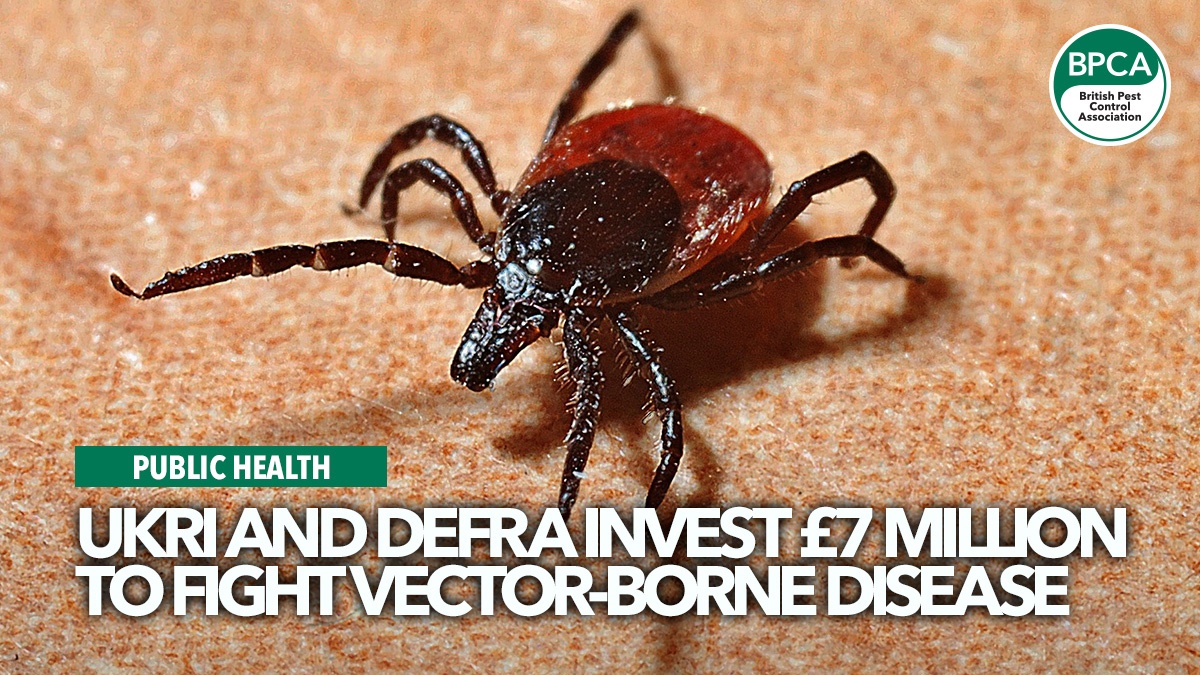
It is hoped that the investment will improve the UK’s research capacity to forecast and mitigate animal and human vector-borne disease threats, which may emerge as a result of changing climate and other environmental changes.
Funding totalling £7,538,757 will support eight research projects seeking to tackle vector-borne disease in the UK.
The investment is a collaboration between:
- Department for Environment, Food and Rural Affairs (Defra)
- Biotechnology and Biological Sciences Research Council (BBSRC)
- Medical Research Council
- Natural Environment Research Council
- UK Research and Innovation (UKRI) strategic themes, tackling infections.
What is a disease vector?
Vector-borne diseases (VBD) are a major threat to global animal and human health. Causing in excess of 700,000 deaths each year, they account for more than 17% of all infectious diseases.
We're familiar with the term disease vector in pest control, but just in case you haven't come across it yet: vectors are living organisms, that carry and transmit infectious pathogens to other living organisms. Common disease vectors include:
- Fleas
- Lice
- Mosquitoes
- Ticks.
Vectors are capable of transmitting a whole host of infectious diseases, both in animals and humans, including:
- Blue tongue
- Lyme disease
- Tick-borne fever
- Yellow fever
- Zika.
A growing risk
Although the impacts of vector-borne diseases are felt mainly in tropical climates, the risk they pose to the UK is increasing, which can be attributed to a number of different factors, from changes in land use to a changing climate.
These environmental changes influence the habitats, geographical distribution, longevity and life cycles of vectors in ways that make disease transmission more likely.
Mosquitoes and ticks in particular represent a growing threat due to the fact that they are both established and invasive to the UK.
Professor Melanie Welham, Executive Chair of BBSRC, said:
"This latest investment by UKRI and Defra epitomises the importance of a ‘One Health’ approach in tackling infections such as vector-borne disease.
"If we are to truly understand the risks posed vector-borne disease, we must first build our understanding of the links between animal, human and environmental health. And that can only be achieved by collaborating across sectors and disciplines.
"The eight projects receiving funding offer real potential to build the UK’s national defence and response capabilities by tackling infectious diseases that pose a genuine threat to people and animals worldwide."
Defra Chief Scientific Advisor, Professor Gideon Henderson, said:
"The funding for this important research, which brings together a wealth of expertise from some of the best scientific institutions in the UK, will continue to build and prepare the UK for the emergence of endemic and exotic tick-borne diseases.
"This coordinated scientific effort forms part of the UK’s commitment to work at the interface between environmental, human and animal health to improve outcomes for all."
Interested in some further reading?
If this has whet your appetite for learning more about vector control, check out this article from PPC101 on 'Infection and immunity in wild rodents'.
Source: Online