To protect the UK’s honeybee populations, scientists have trialled electronically tagging invasive Asian Hornets.
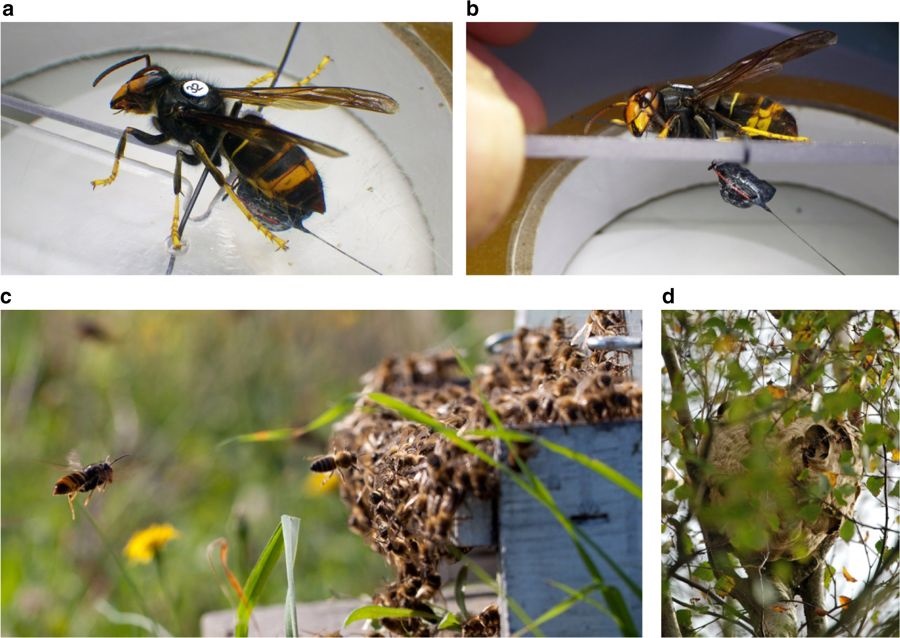
Scientists from the University of Exeter have been trialling the use of tiny tracking devices to follow Asian hornets to their nests – marking a revolutionary way of identifying established colonies.
Risk to bees
Asian hornets (Vespa velutina) prey on honeybees, one of the UK’s most important pollinators.
Asian hornets are already well established across much of Europe, however other than a couple of isolated incidents in Britain, the invasive pest is not yet well established on our shores.
The only way to prevent the spread of the hornets is detecting them early and destroying their nest.
Adult Asian hornets hover outside bee nests, grab an unsuspecting bee, then dismember it before taking it back to their nest to feed to larvae.
Vespa velutina nests are usually well hidden, and workers travel large distances, making them hard to follow.
It is vital to find the nests early in the season to prevent the hornet spreading, as later in the year hundreds of new queens emerge and disperse from each nest, each with the potential to make new nests.
Professor Juliet Osborne, a co-author on the study, Director of the Environment and Sustainability Institute
Using the radio devices, scientists from the University of Exeter have managed to follow Asian hornets up to 1.33 km back to their nests.
The researchers used the smallest radio tags commercially available, which had to be attached to the hornets with sewing thread.
Asian hornets were able to carry the trackers as long as the total load was less than 80% of the insect’s weight.
Trials of the technique in the south of France and Jersey found five previously undiscovered nests.
The work was funded as part of Defra’s efforts to prepare for future outbreaks of the Asian hornet in the UK.
South West beekeepers also have supported the project with funds of their own.
This work is key for ensuring a rapid response to Asian hornets when sightings are confirmed, and in future, bee inspectors will be able to use this technique to take swift action.
Nicola Spence, Defra Deputy Director for Plant and Bee Health
Asian hornet watch
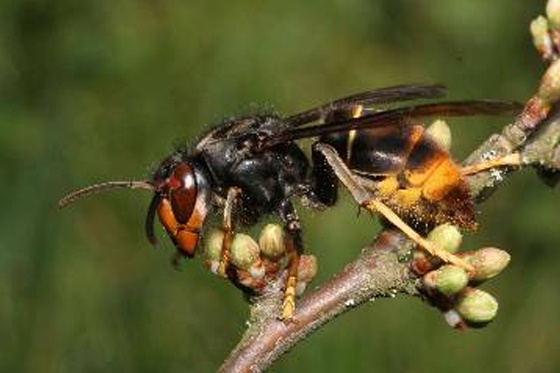
Asian hornets are smaller than native European hornets.
They have a mostly dark brown or black body and yellow-tipped legs, a distinctive orange-yellow stripe near the end of their abdomen, and often a thin orange-yellow line just behind the “waist”.
Unlike the European hornet, the Asian hornet’s face is orange, and the back of the head is black.
Any suspected sighting of an Asian hornet should be reported, ideally with a photo, via email to alertnonnative@ceh.ac.uk or by using the Asian Hornet Watch app.
The paper, published in the journal Communications Biology, is entitled: “Searching for nests of the invasive Asian hornet (Vespa velutina) using radio-telemetry.”
Source: Online