PRESS RELEASE
Chris Venables of Venables Pest Control was asked to tackle an infestation at an environmentally conscious site using Selontra, despite abundant competing food sources.
Through strategic monitoring, bait station mapping, and gradual bait introduction, full control was achieved in just 12 days.
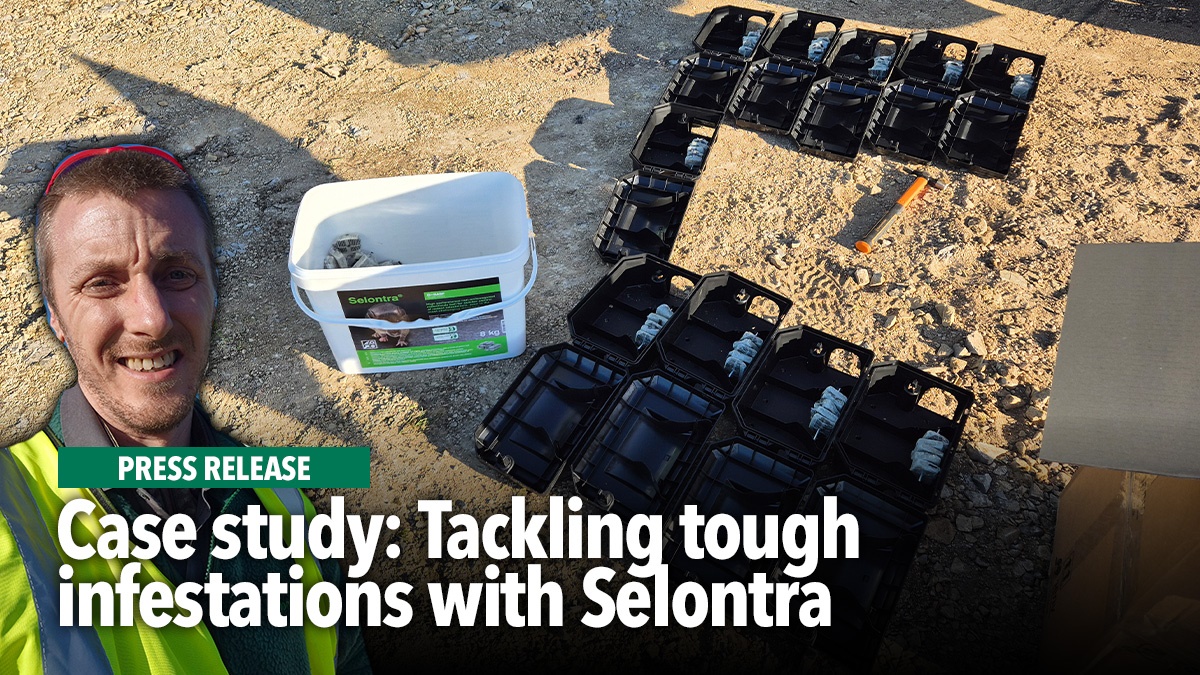
Chris was called to a site in Malmesbury that specifically requested the use of Selontra due to their awareness of the environmental issues surrounding the property.
As the site had a substantial amount of biomass present, including cut maize, garden waste, and leftover tailings from biogas production, Chris knew this infestation would be difficult.
Since these food sources could not be removed due to sheer quantity, they posed a significant challenge in the rodenticide application approach and uptake.
Chris said “Any competing food sources can be an issue when it comes to effective rodent control. Good practice dictates these sources need to be removed or secured as best as possible. This unfortunately could not be done on this site due to the sheer amount onsite.”
Upon the initial visit, Chris observed direct rodent activity travelling from burrows to food sources with minimal deviation.
Birds of prey were present, creating additional complications on the approach to control due to the risk of secondary poisoning.
To address this, Chris mapped 16 existing baiting stations embedded in the environment and established 30 new bait locations around the food storage clamps and waste areas.
“To assess the infestation and the likeliness of neophobia, I positioned ten old baiting points, each with Monitoring Paste to see whether the rodents would access these stations or not, and the other areas were fitted with traps,” explained Chris.
Monitoring and baiting process
Chris conducted a 12-day monitoring programme using the non-toxic Monitoring Paste and traps to assess rodent activity.
Key findings included:
- All non-toxic blocks in the old baiting points were consumed within four days
- It took an additional four days to achieve good consumption in the new bait stations
- Rodents remained close to their established areas, demonstrating neophobia and an abundance of alternative food sources.
Chris explains further: “Interestingly, all Monitoring Paste blocks were consumed within four days in the old baiting points, and it took a further four to obtain good consumption in the new bait stations that were positioned around the equipment containers.
"Neophobia and adequate food sources were keeping them confined to their areas, and it was clear that they had no need to venture further. This led me to trap in areas that had very low activity and change to Selontra in and around the food source areas with confidence that they will persevere to enter and ultimately, consume the bait.”
Following this assessment, Chris transitioned from non-toxic Monitoring Paste to a Selontra application.
To ensure effective control, an adequate quantity of Selontra was required for the first seven to fourteen days. Seven blocks per station were applied, and site visits were conducted every few days.
Results and long-term strategy
Rodent uptake was rapid over a ten-day period, with 90% of bait stations requiring refilling at each visit.
However, after this initial phase, bait consumption abruptly stopped. Visual indicators such as burrow activity, droppings, and sightings also ceased, signifying successful control.
Months later, Chris transitioned back to traps and non-toxic Monitoring Paste. However, due to the site's location and high food availability, a permanent baiting regime in targeted areas was justified.
Traps remained on the perimeter, while permanent baiting using Selontra was maintained in the key zones.
Key learnings and best practices
- Preparation is crucial before applying Selontra. Competing food sources must be considered, and whenever possible, removed or secured
- Non-toxic Monitoring Paste provides a more accurate estimation of rodent numbers than visual assessment alone - in this case, monitoring revealed a higher population than initially anticipated
- Gradual bait introduction by securing bait stations, allowing rodents to investigate, and applying Selontra after seven to ten days enhances uptake and control efficiency
- Site cooperation is essential - the presence of an observant and responsive site manager greatly accelerated the effectiveness of the rodent control measures.
By the end of the initial 12-day treatment, 3kg of Selontra was used, resulting in complete control of rodent activity.
As a precaution, Chris planned to revert to traps and Monitoring Paste, with regular visits every 12 days to ensure continued effectiveness, and the site staff remained vigilant in reporting any activity.
Wildlife and environmental considerations
A positive outcome of the treatment was the local birds of prey and other non-targets remained unharmed.
Over the course of the intensive treatment, 96 dead rats were removed, with additional rats being caught in traps over a six-month period.
The site's well-maintained vegetation and cooperative management made servicing the location efficient and effective.
Final observations
Chris emphasised that sites unwilling to comply with proper preparation - such as addressing competing food sources, hygiene, and proofing - compromised rodent control effectiveness.
In cases where these conditions were not met, Chris chose to withdraw from servicing such locations, reinforcing the importance of preparation in achieving successful control.
To find out more about Selontra, visit the BASF website.
Source: BASF press release