Technical | PPC99 May 2020
In this article Clive Boase, Principal Consultant at The Pest Management Consultancy explains the importance of correct insect identification and how you can make a start on learning the basics.
SPEED VIEW
- Correct insect identification helps us comply with CoSHH Regulations
- Pesticides should be reserved for pests identified as a real threat
- There are several common sense reasons for needing to correctly identify pests, excluding legislation
- Best way to identify an insect is by using an ‘identification key’
- If you’re carrying out identification for clients you will need the right equipment
- BPCA runs a one-day insect identification course which lays the foundation for building identification skills.
We’ve all been there. You are with a valued customer in their premises, when they spot several tiny, dark objects on the floor, and ask you what they are.
What do you do? Bluff? Collect a few and say you’ll let them know? Or give them the full text-book explanation?
Of course, we’d all love to be able to provide option three, but how do we gear up to be able to do that? And in any case, do we really need to identify everything?
From a regulatory angle, the need for identification is clear. The Health and Safety Commission, in their guide to the interpretation of the CoSHH Regs for pest controllers, say that:
“The decision to apply a pesticide or not should only be made after... correct identification of the pest.”
The thinking behind this statement is that we shouldn’t be using potentially harmful substances if the target is actually a casual intruder of no real threat to the customer.
Pesticides, if we need them at all, should be reserved for those pests that have been identified as a real threat.
Like most regulations, we comply with the CoSHH Regulations not simply because it is ‘the law’, but because there are also good common-sense reasons for compliance.
Boosting your identification skills can take place in different ways.
For some pests, especially the larger ones such as cockroaches and a few others, a thumb through your British Pest Management (BPM) manual, or a quick look at some images online, may be enough to put a name to a pest.
For these larger and boldly-marked pests, the distinctions between different species are usually obvious.
The dramatic improvement in online material in recent years has also been a big help, with websites that specialise in high resolution images of particular types of pests.
However, there are many more insects where the differences are not so obvious. Most of the ants, stored product pests, flies and so on, often appear very similar at first sight.
You can stare at different pictures online for as long as you like, but this alone won’t enable you to reliably tell the Garden ant from the Argentine ant, or the Fruit fly from the Scuttle fly.
The keys to the kingdom

For these smaller insects, the only reliable way to identify them is to use what is known as an ‘identification key’.
Identification keys consist of a series of linked, step-wise questions that will eventually, if we answer them correctly, take us to the name of our specimen.
Keys exist for most of the more important insects, but they are often scattered through a variety of books and online sources.
There are some excellent keys that are in books which are now out of print, so you may have to search via Amazon, or secondhand book dealers.
Some keys can appear challenging to use at first, as they often use quite technical words to describe particular details of the insect.
However, like anything else, once we become familiar with the terms used, and with the routes through the key itself, then they can become a joy to use.
If you are carrying out identifications yourself, then as well as keys, you will almost certainly need a decent hand lens.
These are available from some pest control distributors, suppliers of entomological equipment or even some high street opticians.
Magnification of 10x is about right for most insects, and even a top-of-the-range hand lens will cost you less than re-fuelling your van.
However, even a good hand lens will struggle with insects where you need to look at the really small details.
Moving up from a simple hand lens, there are now a range of options, depending on what you want to do and how techy you feel.
At one level, there are now apps for your phone that enable you to obtain reasonable magnified images of small insects.
Alternatively, you could buy a small digital microscope that connects to your phone or laptop, to see the magnified images. The great thing about digital microscopes is of course that you can save images, and send images.
Or you could buy a traditional optical microscope, similar to the ones used by BPCA.
A decent office-based microscope that will enable you to carry out all your pest identifications won’t cost a fortune; in fact, no more costly than a couple of packs of premium insecticide gel.
If you are carrying out identifications yourself, then as well as keys, you will almost certainly need a decent hand lens.
Clive Boase, The Pest Management Consultancy
All frills, no skills?
However, as usual, it’s not just about the kit. Somehow you also need to pick up the skills and experience to deal with all those tiny samples, and fortunately, there are opportunities.
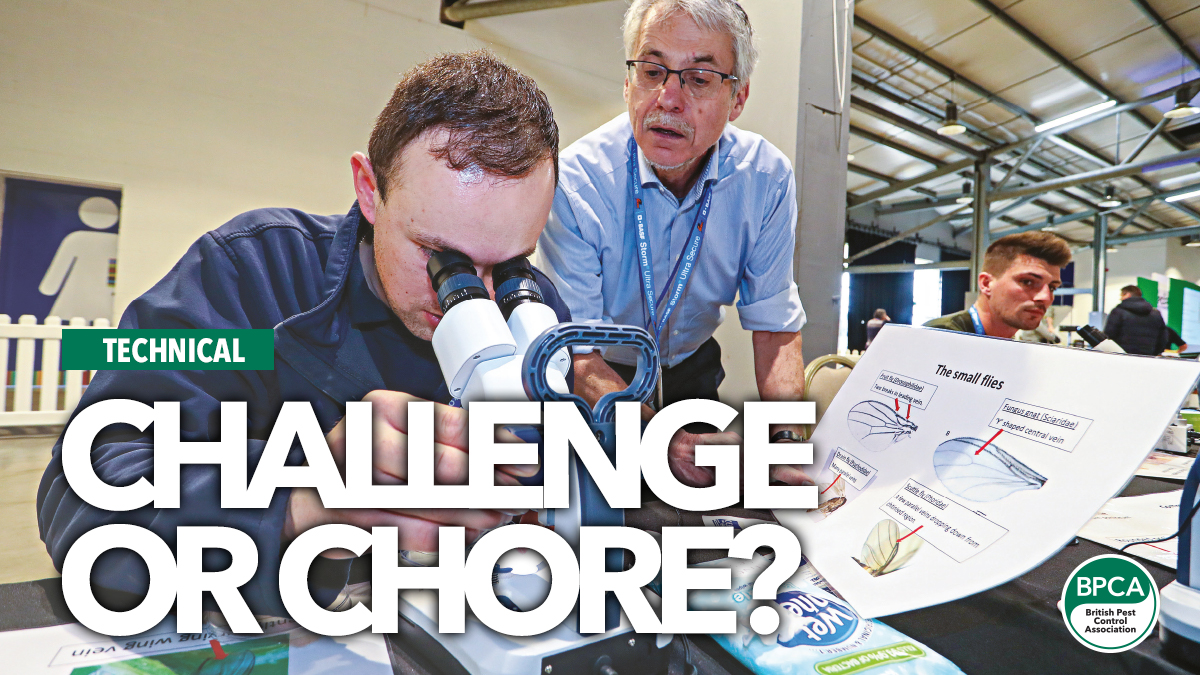
At PPC Live in Harrogate, BPCA held a drop-in insect identification surgery, where there were a number of microscopes, samples of insects, explanatory charts, books of identification keys, and expertise on-hand for those who needed it.
The surgery worked in different ways for different people. Some people were seeking help with their own tricky-to-identify samples, while others sat themselves down and carefully worked through all the various samples provided.
And there were others who soon forgot about actually identifying the insects, and just marvelled at the new world of invisible detail that a microscope can open up.
The PPC Live event was a really good ‘taster’ session, providing basic insight into the world of identification.
For those keen to take their identification skills to another level, BPCA runs an insect identification course.
It’s a full and structured one-day course, which covers the ‘why’ and ‘how’ of insect identification, and works through the main insect groups and pests.
There is also the opportunity to bring your own samples and get some guidance on how to identify them.
The course provides a solid foundation for the keen technician, on which they can start to build their identification skills and impress their clients.
And if you’re on a CPD scheme like BPCA Registered, you can get 10.5 points for the day (12 points for Basis Prompt) to go with your new-found knowledge of entomology. Find out more at bpca.org.uk/training
Source: PPC99