PRESS RELEASE
More research is needed into the role of pest management in protecting the public health, a national trade body has said.
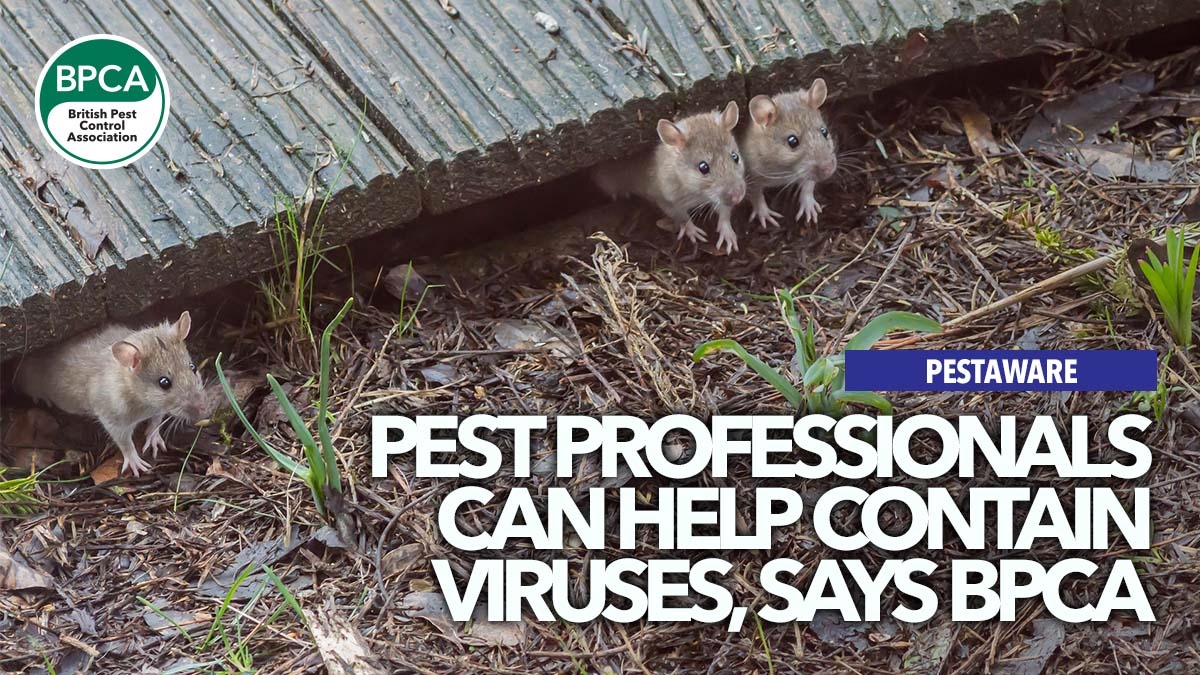
Experts at British Pest Control Association (BPCA), have been examining studies around rats and mice and their role in the spread of viruses such as Avian flu and Covid-19.
Pest professionals work to manage rodent populations that pose a risk to the health of individuals or the public – and BPCA believes more research into their role would help build further barriers to the spread of disease in the future.
BPCA member and industry expert, Alex Wade, of Wade Environmental, said research* into the spread of the Omicron variant of Covid-19 illustrated how viruses can travel via the rodent population – and urged householders and businesses to prioritise professional pest management going forward.
Alex said: “Pathogens can travel from pests to people with comparative ease, through contact with urine, a scratch or other seemingly-innocuous events.
“These diseases are known as ‘zoonotic’ which means they can move between species – although this often results in mutations which alter the way the virus works.
“However, there is also the potential for viruses to move from human to pest and back again – this process, in part, is known as ‘reverse zoonosis’ and scientists are examining it in relation to the Omicron variant of Covid-19.
“The research indicates that Omicron was either hiding in a population of untested humans, had been circulating within humans who were significantly immunocompromised, or transitioned into an animal and then transitioned back again.
“There is evidence that mice could be the culprit for this reverse zoonotic event. The speed of the mutation indicates an animal with a rapid life-cycle – such as mice – and studies of the receptor’s sites on the surface of mouse cells seem to be perfectly shaped to accept these spike proteins of this new variant of the virus – or rather, vice versa.
“But the research is still in the early stages and we can’t rule out some other, unforeseen cause.
“However, lab tests have shown that such a zoonotic event is more of a ‘when’ than ‘if’ scenario, so it’s important that we prioritise pest management and ensure rodent infestations are dealt with quickly and safely by a professional such as a BPCA member.”
...there is also the potential for viruses to move from human to pest and back again – this process, in part, is known as ‘reverse zoonosis’ and scientists are examining it in relation to the Omicron variant of Covid-19.
Alex Wade, Wade Environmental
Research is also on-going into the role of rats and mice in the spread of Avian flu, with current evidence pointing to rodents carrying the virus on their fur after coming into contact with wild birds, their faeces or communal drinking areas.
Dee Ward-Thompson is Head of Technical at BPCA. She said: “Our members are on the frontline of pest management and undergo thorough training, so they are able to deal with a pest issue quickly and safely as well as offer advice on preventing further problems in the future.
“It is essential we do all we can to contain the spread of viruses like Covid-19 and Avian flu, so we would urge anyone who has concerns about rodents to contact a member of the BPCA without delay.”
BPCA members are trained, experienced professionals with access to a range of specialist products not available to the public.
They are trained, qualified and regularly assessed to the British Standard in Pest Management BS EN 16636.
To find a professional pest controller visit bpca.org.uk/find
*Research referenced in this article includes a recent paper in the Journal of Genetics and Genomics, studies into the Omicron variant by Dr Mark Viney and his team at Liverpool School of Tropical Medicine and a study into Avian flu by Francisca C Velkers.
Source: Online