PPC121 | OPINION
As pest managers look to incorporate more technology into treatment plans, Tom Holmes, of Tom Holmes Consulting, shares some of his thoughts on the benefits of remote monitoring and how we can sell these services to clients.
GUIDANCE - BPCA has created guidance for using wildlife cameras in customer premises. We outline how to stay ethical, legal and professional. bpca.org.uk/g/camera
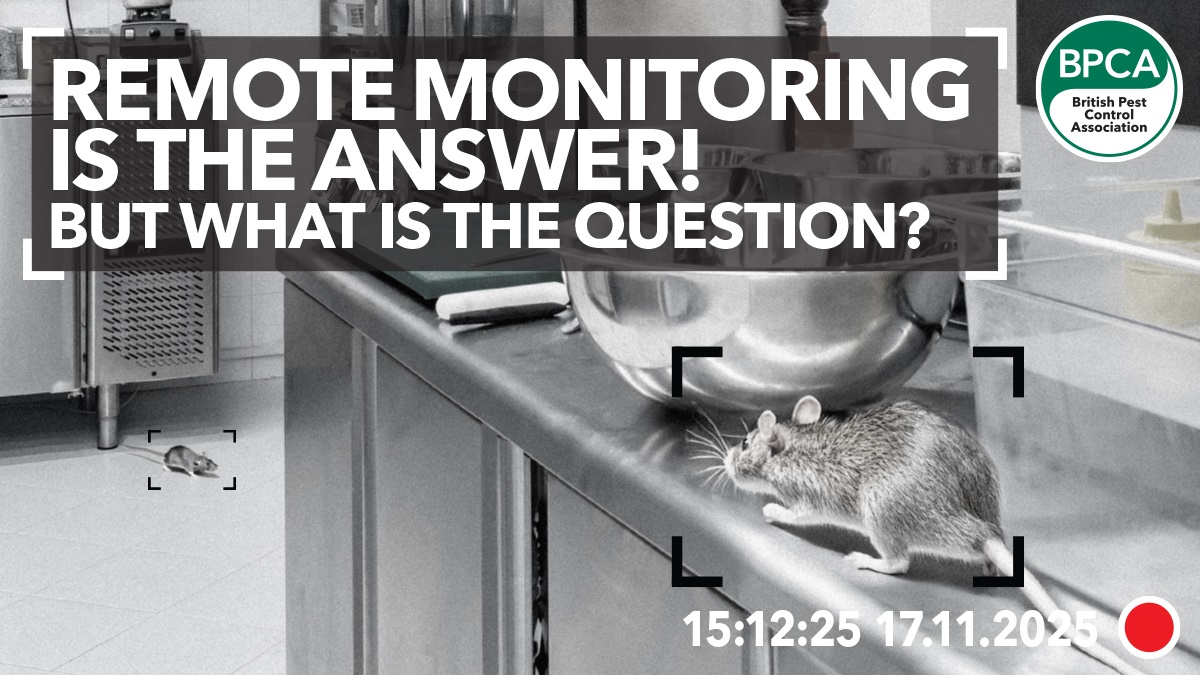
For several years we’ve been presented with multiple new remote monitoring solutions for rodent management. In many ways, it’s a bit overwhelming to understand how they all work and where they might fit.
The feedback I get from service companies, both within the UK and further afield, from sole traders to multi-nationals, is mixed at best. But given some of the real challenges our industry is facing right now, surely these solutions should be a great fit for our traditionally ‘old school’ industry?
Cards on the table time. My personal view is that there has to be a place for real-time, remote monitoring within professional pest management. And I’m going to make the case for why.
Firstly, let’s agree what’s the problem that we’re trying to solve. I’ve spoken before about how I believe that our role as the professional pest management industry is to help customers maintain public health, using our skills, professional expertise and available tools to manage the risks associated with pests.
But specifically, what ‘problems’ does remote monitoring have the potential to help us with?
First off, let’s be clear – Nothing will replace the fundamentals of environmental management, (removing food, water and harbourage) and proofing sites, delivered by trained professionals. They are, (or should be), givens.
That accepted, it could be argued that traditional methods for monitoring rodent activity can be labour intensive, reactive, unfocussed, inefficient and inconclusive.
That’s not to say that our long-relied-upon tools of snap traps, monitoring baits and rodenticides (RIP to glue boards?) won’t continue to be the key tools for us going forward. But for genuine monitoring, I’d suggest technology should now be able to help us out.
Let’s agree upon what we are talking about here: whilst I believe the ‘product’ these technologies can give us is ultimately insight, we must accept there’s going to be some techy kit required.
Typically all remote monitoring systems have four elements to them:
- A device to capture the data (ie cameras, snap traps, pressure sensor pads)
- A communications mechanism to transfer the data from site (cellular, wi-fi, loRa)
- A cloud-based storage area for data (a huge warehouse somewhere in the world, full of servers)
- A visual representation of the data (an app, web-portal or integration with an existing back-end system).
The most familiar part to us all is usually ‘the device’; often a relatively standard-looking snap trap with a small box of electronics bolted on, or possibly some sort of detection device, (camera, motion sensor, heat sensor or pressure sensor), often packaged up in a pretty familiar-looking rodent station style box.
That’s the kit required, and there are multiple types of all shapes and sizes available to us. But rather than talk about specific solutions, let’s consider what the concept of remote monitoring can bring to the party.
I believe there’s plenty.
Improved service
The brutal truth is that we’re a reactive industry. We go to a site, do some work, leave some kit, then come back in six weeks and deal with whatever we find.
Or worse, we get an unscheduled callout from the client, screaming that there’s a mouse running around in their factory, taking a hit to our profitability and reputation.
Real-time, remote monitoring has the potential to flip this, providing the peace of mind of 24/7 monitoring to our clients.
And should the worst happen and there be some rodent activity, we’ll know about it long before the customer, (and should we choose to do so), be on site to start dealing with it before they even know there’s a problem. That is real service.
Boost sustainability
We know that large end-users are hugely motivated by their sustainability programs, often with targets in place and positive noise made about the part they’re playing.
If we can detect pest problems as they emerge, we can intervene earlier, likely resulting in more targeted treatments, fewer chemicals used and fewer unscheduled site visits in vans.
Tick, tick and tick!
Improved efficiencies
Like them or not, rodent stations provide a safe and professional environment to monitor, trap, (and if necessary), safely house rodenticide over the treatment period. However, as we know, large sites may have tens of rodent stations, all of which require regular inspection.
That’s a physical and time commitment; to get on our knees, open each station, evaluate what we find and maintain as appropriate.
Then, if we have identified an increase in rodent activity, the real work starts.
Remote monitoring devices should be able to tell us where the activity is before we even get to site, and when we do, we can target these locations straight away to find the root cause.
With this focussed approach, as service companies, we are provided with the choice of either spending less time on site for that visit but providing a better service and improving our profitability, or spending the time we do have on site more efficiently, doing ‘actual pest management’, rather than walking the site and opening boxes.
Typically, we would gratefully accept a bit of both.
Help manage the recruitment crisis.
We’re all feeling it. How do we retain and attract employees at a cost that keeps us profitable?
Being a technician is a tough job. Early starts, highly physical, demands investigative skills and to safely use toxic chemicals.
It’s a hard sell. And somehow, we’ve got to balance increasing operational costs with fair wages.
Amongst the well-publicised crisis of an aging workforce, if we’re going to both keep the experience we have and attract new talent, any tools that have the potential to simplify the physical demands of the job, upskill more recent recruits and attract tech savvy younger generations, has to be strongly considered.
Insight (the jewel in the crown of benefits!)
All the benefits above are highly relevant, and highly impactful to service companies and end users. But at its heart, real-time remote monitoring provides us insight that simply isn’t available through traditional methods.
Currently, when I return to a site, I have to inspect every monitoring location manually, assess what I find, and capture the data it provides.
But typically, the only data I get is that either there was no rodent activity in this location, or that at some point in time since I was last on site, one or more rodents has been here.
With remote monitoring, I should be able to learn how many individual instances of activity there were, at what time and whether there were patterns in reported activity.
And if I’m really clever, and combine the data from multiple monitoring locations, potentially what direction and route rodents take. At this point I feel the need to make my case for why, whilst snap traps can be used for monitoring, they are at their best when used as part of an approach to control. Controversial? Well, what does a rodent caught in a traditional snap trap tell us?
The only true insight we gain is that at some point since we were last on site, one rodent, at one point in time, was in that space. We know nothing else; the time, frequency or scale of rodent activity.
In addition, when triggered, the snap trap is entirely useless to us for ongoing monitoring and can provide us with no further details of what’s happening on site. By adding a remote monitoring aspect to a snap trap, we get a bit more information when that single rodent was trapped. But the device then remains equally useless for us until reset.
For this reason, monitoring devices that use some form of activity sensor, (motion camera, heat sensing, pressure pads, etc), and deliver ongoing rodent monitoring throughout the period between site visits, would be my choice of remote monitoring tool. With that precious information in the form of data, I’m armed to get straight into managing the problem, days and potentially weeks, before I would go through traditional methods.
The elephant in the room
So far, all good. But then we face the elephant in the room. How do we charge for these solutions? Manufacturers are still wrestling with their pricing models for their systems.
Typically, we see:
- A high device cost and no (or a low) ongoing cost
- A low device cost and high ongoing cost (typically a subscription)
- A mix of the two.
Challenging, whichever way.
I believe the fundamental issue service companies have here is that, typically, we sell our service in terms of time spent on site.
Whilst I could talk passionately about how what we actually do is provide a service, reducing risk to end-users and their customers through managing public health pests, the brutal truth is that most service companies quote and then charge by the hour.
How much to service that site? One technician, eight site visits per year, two hours to get around the site each time. That’ll be [insert number here] per month, please. And our customers get the comfort of seeing our van in their carpark for a few hours on each occasion.
To truly enjoy the efficiency savings remote monitoring can give us, and help us deliver an improved service, we’ll have to flip that on its head.
If not, we’ll end up saying “We’re going to charge you the same, possibly more, but you’ll see us for less time each visit”. That ain’t going to cut it. No, to get our customers to see the benefits to them, we’re going to have to shift the conversation from hours on site to value delivered.
From vans seen in carparks to 24/7 protection. From reactive blanket treatments, to proactive, insight driven, targeted action.
That requires effort. But the benefits? All of the above. To be clear, not for one moment do I believe remote monitoring technology replaces technicians. It’s simply a tool. But a tool that can help trained professionals do their job better and more efficiently.
To use a crude analogy: rather than a security guard in a peaked cap walking the site once every six weeks to have a look what’s happening, they’re armed with information delivered through a high-tech, data-delivering, 24/7 surveillance security system, which allows them to spend their time doing what they do best.
Easy? No. Simple to bolt on to the standard service company business model? Unlikely.
But if we as an industry can find a way to truly embrace remote monitoring and the benefits it brings, we can super-charge the pace of our journey to show the value of professional pest management and its crucial role in maintaining public health for us all.
“Traditional methods for monitoring rodent activity can be labour intensive, reactive, unfocussed, inefficient and inconclusive.”
Source: