PPC124 | TECHNICAL
Alex Wade, Global Technical Marketing Manager for BASF’s rodenticide range, explores what secondary poisoning is, why it matters, and how professionals can reduce the risks while maintaining control. Based on his talk at BPCA Digital Forum 32, Alex discusses secondary poisoning and how understanding it is critical to doing our job responsibly.
Primary vs secondary poisoning
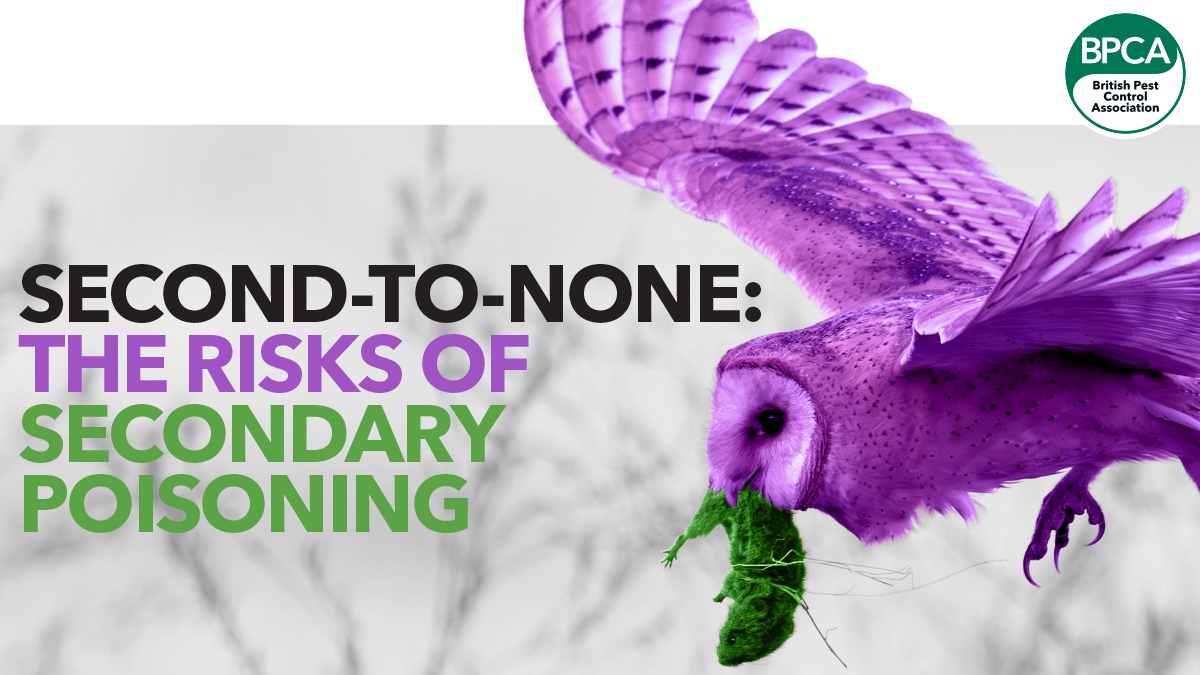
Let’s start with the basics. Primary poisoning happens when a non-target species eats bait directly. Secondary poisoning is when another animal eats something that’s already consumed the bait. Think of a barn owl dining on a poisoned mouse. The process looks like this:
- You deploy bait
- A target rodent eats it (or sometimes a non-target animal does - that’s still primary poisoning)
- Then a predator or scavenger eats that animal, ingesting the active substance stored in its tissues.
That’s secondary poisoning in a nutshell.
But here’s the kicker: for secondary poisoning to occur, the active ingredient has to be bioaccumulative, meaning it stays in the body rather than being fully metabolised. And that’s where the real risk comes in.
A look at the evidence
If you’re thinking, “How big a problem is this really?” here’s a stat that should make you sit up: almost 90% of barn owls tested in the UK showed traces of anticoagulant rodenticides (source: CRRU Wildlife Reporting Scheme, 2016–2021).
Now, consider this: barn owls don’t eat only rats, and certainly not very many adult rats. Their diet is almost entirely composed of non-target species, including field mice, voles, and shrews. Yet they’re still testing positive for rodenticides. That tells us that these chemicals are moving through the food chain in ways we might not always anticipate.
Secondary poisoning isn’t just a theoretical risk. It’s real, and it’s on us as professionals to minimise it wherever possible.
Understanding risk
Risk management is at the heart of professional pest control. When we talk about risk, we’re not just thinking about efficacy, we’re thinking about the cost to non-target species.
The CRRU Code of Best Practice sets out an escalation hierarchy for control:
- Environmental management
- Physical controls
- Chemical options (only when necessary).
That means start with habitat modification, escalate to traps, and use chemicals as a last resort. The aim? Maximum impact on the infestation, minimum impact on everything else.
But even when chemical control is unavoidable, we’ve got plenty of tools to reduce risk. Enter the mitigation hierarchy.
The mitigation hierarchy: step by step
Here’s how we apply it in the field:
1 ELIMINATION
The most effective way to avoid secondary poisoning? Don’t use rodenticides at all. If you can solve the problem with environmental or physical measures, do it. But let’s be realistic - that’s not always possible.
2 SUBSTITUTION
Choose the right active for the situation. This is where knowledge makes the difference. If secondary risk is high (think: a rural site with lots of raptors), using an active like cholecalciferol instead of an anticoagulant can drastically cut secondary risk. Why? Because cholecalciferol doesn’t bioaccumulate - it’s metabolised before death occurs.
If primary risk is the bigger concern (e.g. lots of domestic animals on site), anticoagulants with an antidote might be the better choice. There’s no one-size-fits-all. The skill is in knowing the tools and matching them to the job.
3 ENGINEERING CONTROLS
How we present bait matters. Loose bait can spill. Blocks can be dragged. Pastes might be better in some environments. Whatever you choose, secure placements properly and inspect frequently - especially on high-risk sites.
4 PROCESS CONTROLS
Your baiting strategy influences risk as much as the active you pick. Saturation baiting might feel safe and familiar, but it leaves bait down longer and increases both primary and secondary risks.
Alternatives like pulse baiting and speed baiting can be game changers:
- Pulse baiting (great with single-feed anticoagulants) uses smaller quantities at timed intervals to reduce overconsumption and waste
- Speed baiting (designed for cholecalciferol) uses its unique stop-feed effect to get control quickly while limiting bait intake.
5 MONITORING
Use non-toxic monitors whenever possible. They condition rodents to take bait later, cut risks when infestations aren’t active, and help you strike faster when the time comes.
Strategies in action
Start with the environment. Remove food sources, restrict access to harbourage, and seal entry points before reaching for bait.
Assess and reassess risk
Every site is different and risks can change. Keep that environmental risk assessment close at hand.
Choose your chemistry wisely
If secondary risk is high, think beyond anticoagulants. If primary risk dominates, factor in antidote availability.
Secure everything
A loose bait block in a farmyard is an open invitation for trouble.
Check, check and check again
Visit frequency should match risk. The higher the risk, the more often you go back.
Educate clients
They need to understand why strategy matters, especially if it means a slightly longer timeline for safer control.
Precision matters
Every bait placement, every strategy choice. These aren’t just operational decisions; they’re decisions about risk. Eliminating risk entirely? Impossible. But bringing it as close to zero as we can? That’s what separates the professionals from the rest.
Use the right tool for the right job and wield it like a scalpel, not a hammer. Because when it comes to secondary poisoning, good enough isn’t good enough.
WATCH THE FULL TALK
You can watch Alex’s full talk at: bpca.org.uk/cpd-videos or @BritPestControl on YouTube.
Source: