PPC121 | OPINION
Ed Cook from Evergreen Rabbit Control in Hampshire examines the unintended consequences of professional rabbit control being lumped in with hunting for sport, championing the role working dogs play in protecting public health, wildlife management and conservation.
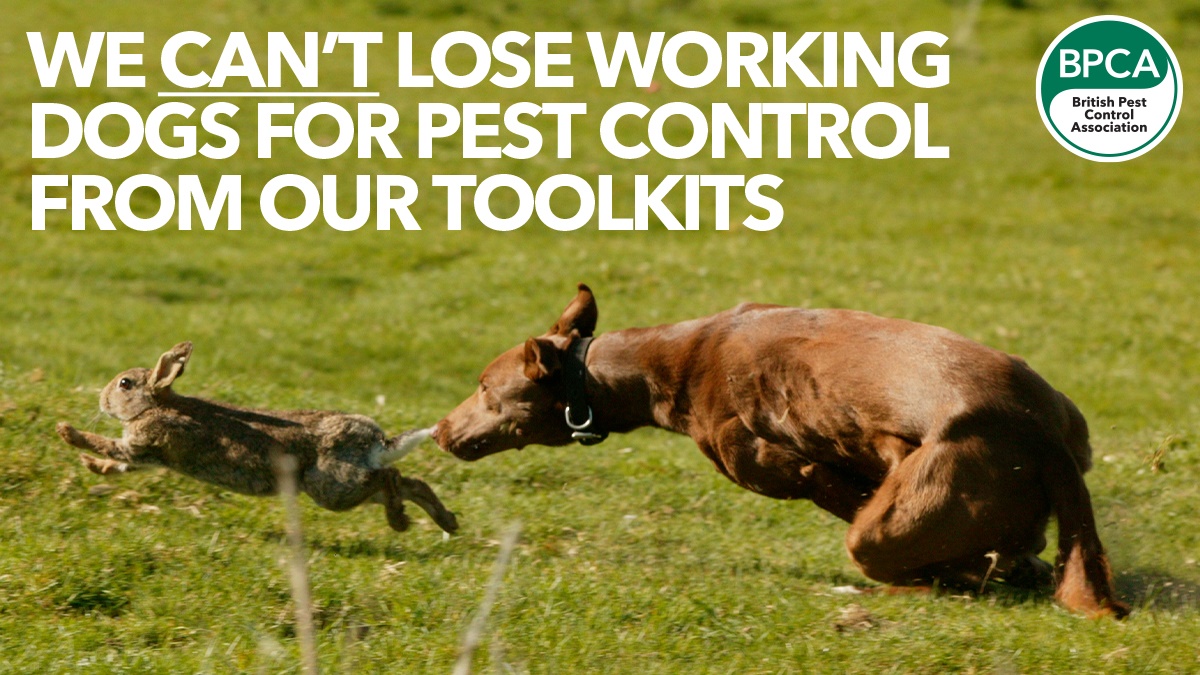
CODE - BPCA has created a Code of Best Practice on Working Dogs. bpca.org.uk/codes (login required)
When the British public thinks of hunting with dogs, they often picture someone better off than themselves, with a name they can’t pronounce, perched on a horse in a red coat worth more than their car. In their heads, they’re on a jolly, harassing a fox with a pack of pooches across the countryside. For many, it’s an easy figure to dislike. That image has been reinforced by the press, poor behaviour by some hunters and misguided animal rights groups alike - some justified, others less so.
But working dogs are a far more complex and diverse subject than many people think, especially in pest control, wildlife management, health and safety, invasive species removal and conservation. People forget that the purpose of a dog−or reshaped wolf, if you like−has always been to aid man. That’s how they evolved. Different breeds were created for different jobs.
Some may say dogs aren’t needed in the “modern world”, but no control method will ever replace a dog in our industry. Their ability is literally ingrained in their genetics. To work with such talent as a much-loved colleague is a privilege.
Times are changing
With pressure from animal rights groups and Labour’s commitment to close loopholes in the Hunting Act 2004 (which allowed rabbit and rat hunting with dogs), rabbit control with dogs may be restricted in England, as it recently was in Scotland.
This legislation was aimed at fox hunting, mink hunting and hare coursing - or those who openly flout the law. Sadly, it also affects those of us who need dogs for real pest control: protecting crops, health and safety, and conservation. There is no replacement for a dog’s ability, and that’s truly concerning.
While many dogs never get to fulfil their original role or live an active life, plenty in our industry are living the dream. Dogs can be used for a wide range of purposes, often more efficiently than traps, chemicals, guns or thermal imaging. In pest control, they’re used to find bed bugs, search for stoats and ferrets as non-native species on islands, and catch rats in places where other methods don’t work.
The dogs love their jobs. They’re versatile, effective across endless tasks and environments, and always keen for more.
Working dogs in rabbit control
For full-time rabbit controllers like us, dogs are the most important tool of the trade, with ferrets a close second. Our jobs vary hugely across the UK. One day we might be in a garden, the next on a large farm, then on to a high-security compound or even an island for conservation, crop protection or sea defence preservation. In every case, we rely heavily on our dogs’ ability to do the job safely, efficiently and without chemicals. Hunting with dogs should be seen as environmentally friendly.
A dog working alongside us during ferreting tells us which holes are inhabited by “marking” them. Rabbits often appear in unexpected places; commercial areas, vents, wall cavities, ducts and even radiators. Sometimes we need a dog to catch and retrieve a rabbit to hand so it can’t escape.
The efficiency of marking and catching shouldn’t be underestimated. What can be done in one day with good dogs could take three days without them. That’s before considering time-sensitive sites and health and safety. The rabbit that would have been caught and retrieved by dogs is the one that matters, especially on eradication contracts. And as we all know, time is money.
Terriers and spaniels are needed to flush rabbits from vegetation once bolted by ferrets, to drive them into nets, or to be shot or taken by a hawk. We often use terriers to chase rabbits from ducts, drainage pipes, under buildings or from the epicormic growth of trees. In areas where firearms are prohibited for safety, we use dogs for lamping−shining a light at a rabbit so the dog can pursue, catch and retrieve it live for dispatch. In some cases, this is more effective than shooting.
These are just a few examples. Our dogs are true game changers. They’ve streamlined our business for 25 years and remain the core of what we do.
The future of working dogs in pest management
Personally, I’d like to see a licensing scheme rather than losing access to working dogs. Some may argue “you can’t license cruelty”, but I believe licensed hunters who pass tests as handlers, with each dog registered for its skill set, would remove bad practice and improve standards for everyone.
For those who understand that all animals need management, and that even “cute” pests like rabbits must be controlled, it’s fascinating to watch dogs work alongside ferrets, nets and even birds of prey. Those who are offended normally shout the loudest, but most spectators soon learn that no rabbits are ripped apart. We work as a controlled team, the rabbits are dispatched quickly, and the meat is used.
As with any method, there are good and bad practices. Done properly, the use of dogs for pest control is far more humane than poisoning, letting cats roam, or causing a deer road accident and driving on without a thought. “Cruelty” isn’t scientific - it’s a perception, often based on opinion rather than fact.
I’d like to think I’m pragmatic. Some of my methods may look “sporting”, but we’ve fine-tuned them into professional tools. While I’m pro hunting with dogs when it’s done correctly, I believe licensing or at least proper training, welfare standards and respect for quarry is the way forward. We should champion our dogs’ abilities and achievements, not restrict them.
There are good and bad people in every trade. Legislation seldom changes the behaviour of those already working illegally. Why should my trade suffer because of others? It’s offensive to be lumped under the same umbrella as those who don’t care. The time has come for accredited hunters before it’s too late.
After all, I don’t like horses. The only red jacket I ever owned was an Adidas one. And I’m certainly not well spoken.
Using dogs for pest management in Scotland
In Scotland, pest management professionals may use dogs to control wild mammals above ground, but there are strict conditions on how this can be done. Under the Hunting with Dogs (Scotland) Act 2023, professionals can use no more than two dogs to flush or search for wild mammals above ground. This may only be done for specific purposes, including:
- preventing damage to livestock,
- woodland or crops
- preventing the spread of disease
- protecting human health.
If more than two dogs are required, you must apply for a licence from NatureScot before carrying out any activity.
Understanding how the legislation applies
When using dogs to hunt or flush wild mammals that are in the open, the Hunting with Dogs (HWD) Act applies. In this situation, lethal control can only be achieved through the use of a firearm or a bird of prey, and dispatch must be carried out as soon as possible to remain compliant.
However, if dogs are used to drive a mammal into a net, once the animal is captured and in your possession, the HWD Act no longer applies. At this stage, the relevant legislation becomes the Wild Mammal Protection Act 1996 and the Animal Health and Welfare (Scotland) Act 2006.
Under these laws, humane dispatch by hand or by other lawful methods is acceptable, provided that it does not cause unnecessary suffering or breach welfare requirements. It is important to note that once a mammal such as a rabbit is captured in a net, it is considered to be in the possession of the individual. Releasing it would contravene Section 14 of the Wildlife and Countryside Act 1981, which prohibits the release of non-native species into the wild.
Controlling invasive non-native species
The Wildlife Management and Muirburn (Scotland) Act 2024 also defines when control may apply to invasive or non-native species. The legislation states that: “Invasive non-native species” means a species which is either: included on the Scottish list of species of special concern, OR not native to the area in which the control takes place and having, or likely to have, a significant adverse impact on biodiversity, the environment, social or economic interests, or human or animal health.
This means that where a mammal is recognised as non-native and has an adverse impact on biodiversity or the environment, control using dogs may fall within permitted purposes. In practical terms, this may include rabbits, which are non-native and widely recognised as highly damaging to habitats and agricultural land.
As always, pest management professionals must ensure any use of dogs or other control methods is lawful, proportionate, and humane, taking into account all relevant animal welfare and environmental legislation. If in doubt, seek legal guidance or contact NatureScot for further clarification before proceeding. 01463 725000 enquiries@nature.scot
PENNY FOR YOUR THOUGHTS?
Do you have a different opinion from Ed’s, or would you like to add something? Feel strongly about another pest-related issue? PPC is the voice of professional pest management. Send us your thoughts, and we might print them in the next issue! hello@bpca.org.uk
Source: