PRESS RELEASE
Writers: Dr Alan Buckle, Dr Colin Prescott, Colin Shawyer. References can be found at the end of the article.
The Campaign for Responsible Rodenticide Use (CRRU) UK has monitored barn owl breeding in collaboration with the Wildlife Conservation Partnership (WCP) every year since 2011.
Over the study’s 12 years, the percentage of successful nests ranged between 23.2% in 2013 and 64.5% in 2014, with the annual average 46.3%. An average 2.9 chicks flew from every successful nest.
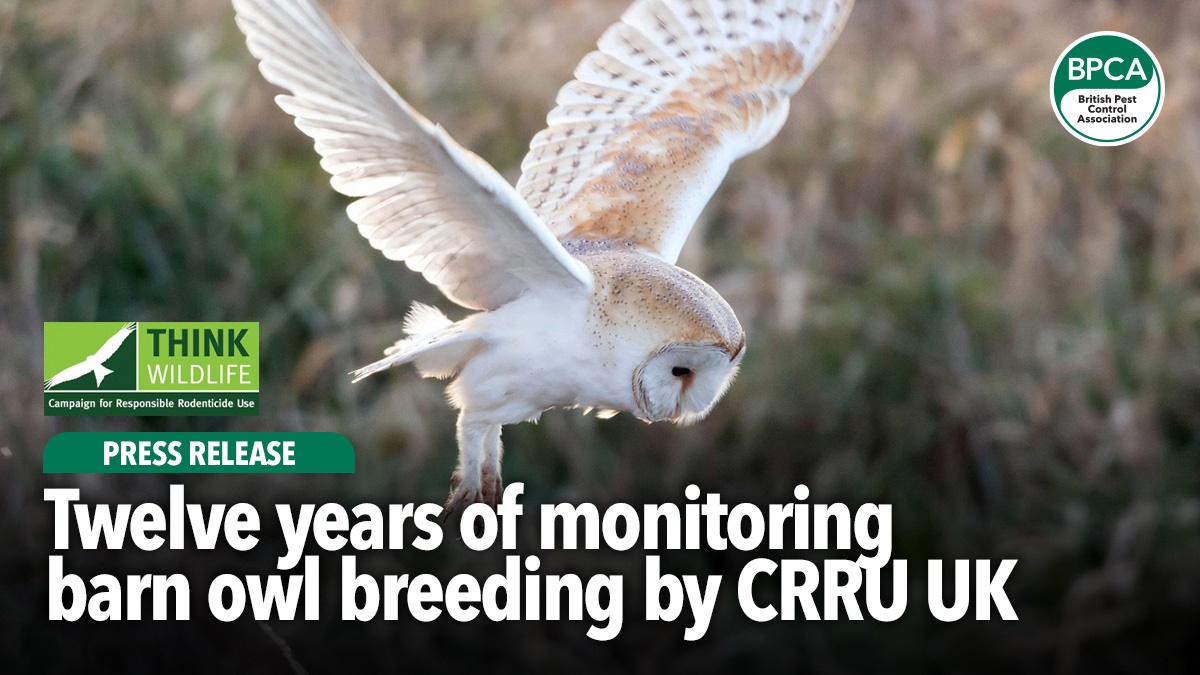
WCP scientists monitored at least 130 nests annually in five regions of England to track nest occupancy, the numbers of eggs laid and barn owl chicks leaving these nests.
The barn owl is the sentinel species nominated by government scientists to measure whether or not the UK Rodenticide Stewardship Regime is meeting environmental targets [Ref 1].
Many of the adult birds studied will have been carrying rodenticide residues that CRRU monitors in another annual survey undertaken in conjunction with the UK Centre for Ecology and Hydrology [Ref 2].
These studies show about 85% of UK barn owls carry, usually, very low residues of rodenticides. Very few owls are killed by these residues and no relationship has been found between residues and barn owl breeding.
CRRU chairman Dr Alan Buckle says, “The intention of the breeding study was to work with barn owl experts in monitoring individual barn owl nest sites over several three-to-four year ‘boom and bust’ cycles of their preferred prey, the field vole. We wanted to see how breeding success changed from year to year.”
The main factors in determining success or failure of barn owl breeding are likely to be prey availability and spring weather, particularly when this involved events such as ‘the Beast from the East’ in 2018, for example.
Having gathered 12 years of results, the study has now come to an end. Over this period, the British Trust for Ornithology (BTO) tells us that almost 92,000 barn owl chicks were raised from nests across the UK.
The last full census of the British barn owl population, Project Barn Owl, was funded by industry and conducted during 1994 to 1996 by BTO and the Hawk and Owl Trust. This was probably an historical low point and only 4,000 breeding pairs were found [Ref 3].
More recent BTO studies show that, in spite of ongoing contamination with rodenticides, barn owls in the UK have increased both in numbers and geographical range since Project Barn Owl [Ref 4].
Colin Shawyer of the Wildlife Conservation Partnership says, “I am delighted by the success of this research and the work carried out by barn owl conservation workers across the country.
"Their efforts have resulted in an increase in the breeding population from 4,000 pairs in 1996 to an estimated 14,000 breeding pairs today, over 75% of which breed in nest-boxes provided by conservation initiatives.”
Reports of the CRRU-WTP studies have been produced annually by the University of Reading and can be found on the CRRU website [Ref 2].
Ref. 1: hse.gov.uk/biocides/assets/docs/rodenticides-stewardship-regime-gog-rev-jan2020.pdf
Ref. 2: thinkwildlife.org/downloads/
Ref. 3: bto.org/sites/default/files/u31/downloads/details/projectbarnowl.pdf
Ref. 4: bto.org/our-science/projects/breeding-bird-survey/latest-results/population-trend-graphs
Source: CRRU press release