INVASIVE SPECIES
The UK Health Security Agency (UKHSA) has published its first Health Security Risk Assessment. They found that there is a low risk from mosquito-borne diseases over the next 5 years, but will become a greater issue over the long term as conditions become more favourable for transmission.
The Health Security Risk Assessment assesses a selection of the UK’s most significant health security risks over the next five years.
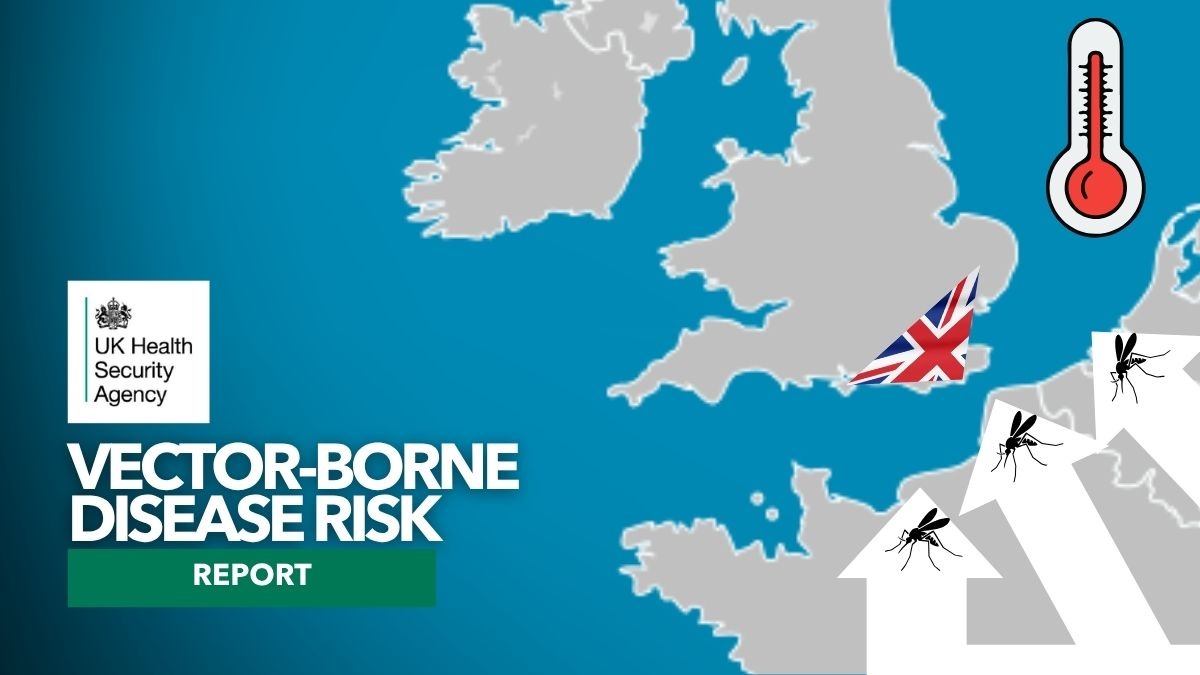
Mosquitoes are not something most UK pest professionals have had to think about in the same way as colleagues in other parts of Europe, but that doesn’t mean we can ignore them.
The overall public health risk remains low, but the direction of travel is clear. Warmer conditions, changing habitats, and increased movement of people and goods all increase the likelihood that new vector-borne issues will become established.
It is designed to complement the existing National Risk Register, which already assesses some health risks, but also has a much wider scope including issues such as terrorism, industrial accidents and conflict.
UKHSA considered several reasonable worst-case scenarios, three of which involved mosquito-borne disease.
West Nile Virus
Spread by mosquitoes of the Culex genus, which can be found natively in the UK, that have previously bitten an infected bird.
Most people infected with the virus have no symptoms at all or experience mild fever, headache, muscle aches and a rash. Only around one in 150 cases will require hospitalisation due to effects on the brain and nervous system.
It is already present in Europe.
In this reasonable worst-case scenario, rising temperatures in continental Europe attract infected migratory birds to the UK, where they are then bitten by local mosquitoes. There will be tens of symptomatic cases. A small number will lead to hospitalisation, with one fatality.
The likelihood of this happening in the next five years is less than 5%.
Dengue Fever
Dengue Fever is spread by Aedes albopictus and Aedes aegypti mosquitoes, which are not native to the UK.
The disease is found in European countries including France, Italy, Spain and Portugal.
It is not always symptomatic, but when it is, it is typically similar to the flu. It can be more severe, with symptoms including bleeding gums or nose, and repeatedly being sick.
In this reasonable worst-case scenario, rising temperatures in Europe lead to an increase in their numbers across continental Europe, and then to their establishment in London and ports along the south coast.
There will be few symptomatic cases, some requiring hospital care, and a small number of asymptomatic cases. There would be no fatalities, but high public anxiety.
The likelihood of this happening in the next five years is less than 5%.
Zika Virus
Spread mainly by infected Aedes albopictus and Aedes aegypti mosquitoes, which are not native to the UK, but also through sexual contact and mother-to-foetus during pregnancy.
Zika is not being spread within Europe. For most people it is mild and not harmful, but in rare cases can cause Guillain-Barré Syndrome and lead to paralysis.
If infected during pregnancy, Zika can lead to the loss of the pregnancy, the baby having an unusually small head (microcephaly), or issues with the baby’s brain, hearing and sight.
In this reasonable worst-case scenario, rising temperatures in continental Europe will increase Aedes numbers, which will reach South-East England, causing a small number of cases. There will be no fatalities or hospital admissions. However, there will be a lot of public anxiety, especially among pregnant women.
The likelihood of this happening in the next five years is less than 1%.
Climate change
The HSRA scenarios are based on climate change making our climate warmer, and more favourable to species like mosquitoes.
Other pests, such as the Yellow-legged Hornet, also benefit from climate change, with their numbers increasing significantly over the past ten years. Having been found to have survived their first winter over 2023/24, reaching as far north as Northern Ireland in 2025 and Wales in 2026.
While the HSRA found that the risks to the UK from mosquitoes over the next five years are low, they warn that these risks will worsen over the longer term.
Policies to deal with climate change do not seek to reverse it, only to limit it. Pest management must therefore be key to the UK’s ability to mitigate against these risks.
GOT ANY QUESTIONS?
If you have any questions regarding the report, drop us an email and we'll try to find you the answer.
[email protected]
Source: Online