PRESS RELEASE
London Network for Pest Solutions is advising care home managers, school maintenance officers and property managers to be on the look out for false widow spiders following an increase in callouts.
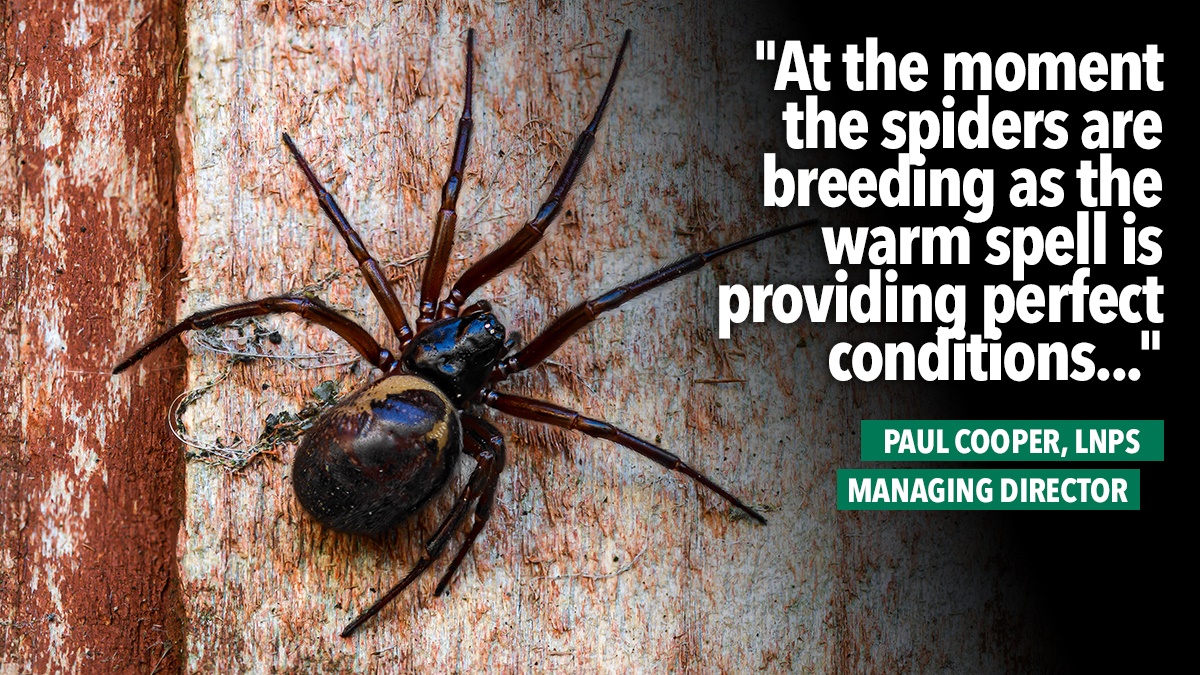
In the last four weeks, LNPS has noticed a considerable increase in the number of callouts relating to the false widow spider, including infestations at a number of schools and, over the Jubilee weekend, a large wedding venue in Essex.
While most healthy adults will experience symptoms similar to a nasty insect bite, the elderly, children under five and others who are susceptible to wasp and bee stings can end up being hospitalised.
With schools closed for the summer break, many authorities are completing necessary maintenance work, making it the perfect time to check buildings for false widow spiders.
About the false widow
False widows are not related to the harmful black widow spider (Latrodectus sp.). They are actually a species in the genus Steatoda.
There are currently six species in the UK, with the most common being the rabbit hutch spider (Steatoda bipunctata), cupboard spider (Steatoda grossa) and noble false widow (Steatoda nobilis).
You are most likely to see the latter, which probably came to the UK in the 1870s, aboard a cargo ship from its native Madeira or Canary Islands.
They can be found in a number of different places but in schools pest controllers often find the spiders in lighting fixtures – especially outside lights.
The larger females, around the size of a 50 pence piece, will use these for warmth and shelter, making them the ideal place to lay eggs.
Unlike other spiders’ webs, which have a pattern, false widow spiders’ webs are random, very fine and they are often on the south-facing side of the building.
Paul Cooper, LNPS Managing Director
Lights also attract other insects, offering a great place to source food. They are ferocious with insects like other spiders and can easily despatch wasps and bees, but it’s only the female spiders that has the ability to bite.
LNPS Managing Director Paul Cooper explains: “We have learned a lot over the last four years of dealing with around 150 cases. We know how they behave and where to look for them. We often don’t see them as they are hiding but two things give them away.
"Firstly, the egg cases and, secondly, the webbing. Unlike other spiders’ webs, which have a pattern, false widow spiders’ webs are random, very fine and they are often on the south-facing side of the building.
"We’ve noticed they get dirty very quickly, after which the spiders seem to abandon them. Through experience, we’ve learned a clean web shows it is being used and the spiders are probably multiplying.
“At the moment the spiders are breeding as the warm spell is providing perfect conditions and they are not coming inside, but as it gets colder they will start entering buildings and be harder to treat. The last thing we want to do is scaremonger, but people need to be aware and be on the look out for these spiders so they can be removed as soon as possible.”
Other places where false widow spiders can be found include wooden sheds, play equipment and gazebos. Wood retains heat, making it an ideal place for spiders to live.
Paul continued: “The bites, while not pleasant, are not particularly dangerous. The spiders do have a venous bite, but it is not very potent to humans and the pain usually only lasts between one and twelve hours. It is comparable to being stung by a wasp.
"They won’t attack unless provoked or threatened, however you cannot have an infestation in a school or risk having your wedding guests bitten. Treating the spiders is not something you should do without the correct equipment."
Treatment includes spraying the spiders and their harbourages including crevices and window sills. The spray won’t penetrate the egg cases so these have to be removed one by one by hand, by pest control technicians in PPE.
The first outbreak was in 2016 in Tower Hamlets. Then in October 2019 several schools in the London were closed after infestations of false widows were discovered during term time. They had gone unnoticed and continued to breed. Around this time LNPS treated more than 100 schools and nurseries.
NEED A PEST CONTROLLER?
If you're concerned about false widows or other pests, contact a pest professional in your area.
bpca.org.uk/find
Source: LNPS press release