A fantastic opportunity to apply for a fully funded University of Reading PhD research project on rodents, pathogens and antimicrobial resistance is now available.
The research, sponsored by BPCA member Killgerm, will look at the variation in the distributions and dispersal dynamics of rodent-borne pathogens, AMR and rodenticide resistance in urban, suburban and rural settings utilising modern techniques and technologies.
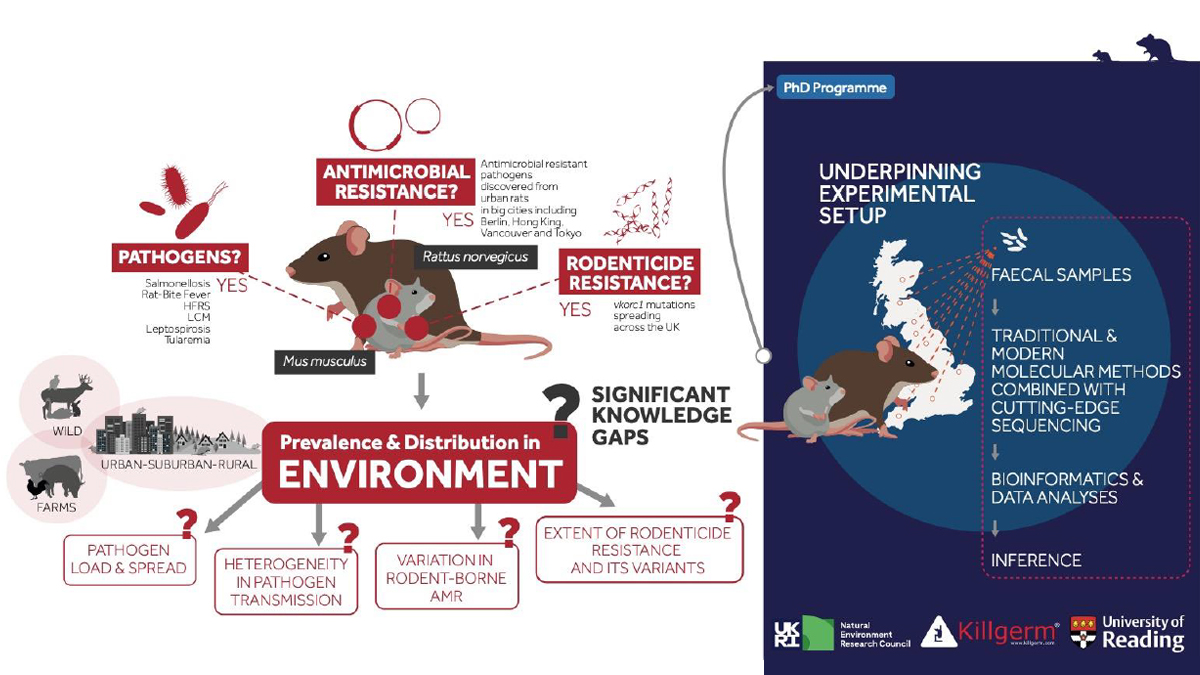
Understanding the Role of Rodent Niche in Dissemination of Pathogens and Antimicrobial Resistance
Lead Supervisor
Dr Soon Gweon, School of Biological Science, University of Reading
Co-Supervisors
Dr Sheila MacIntyre, University of Reading
Dr Colin Prescott, University of Reading
Dr Alan Buckle, University of Reading
Dr Matthew Davies, industry supervisor, Killgerm Chemicals Ltd
Background
Rats and mice are one of the most prolific and widespread wildlife species. They are ubiquitous in urban and rural environments, are in contact with sewage effluents, have a generalist and opportunistic diet and interact frequently with human wastes.
While they cause considerable physical damage to buildings and utilities, they pose even more serious risks to public health by spreading disease. They are known to carry a wide range of pathogens including many species of bacteria, viruses, protozoa and helminths.
In addition, a number of recent studies have found that rodents harbour significant antimicrobial resistance (AMR) bacteria including multidrug-resistance Enterobacteriaceae and methicillin-resistance Staphylococcus spp.
To exacerbate the problem further, surveillance work undertaken by the members of our supervisory team in 2019 revealed that 93% and 61% of house mice and rats carry at least one rodenticide resistance gene respectively - among rats, nearly half have inherited the gene from both parents, the most severe form of resistance.
Despite these known and emerging threats, the role of rodents as reservoirs and/or vectors of pathogen AMR as well as the extent of their resistance to rodenticide is still poorly understood.
Through this PhD programme, we propose to understand the variation in the distributions and dispersal dynamics of rodent-borne pathogens, AMR and rodenticide resistance in urban, suburban and rural settings utilising modern techniques and technologies.
Methodology
A central novel theme to this project is the application of cutting-edge molecular techniques and bioinformatics to rapidly identify pathogens, AMR and rodenticide resistance in single samples. A key concept underpinning this project is the use of faecal samples to screen rodents for pathogen-load, presence of AMR and host rodenticide resistance.
An important and unique aspect of our project is our UK-wide sampling of rodent faecal samples from the existing network of collaborating pest controllers coordinated by Action
Groups including Rodenticide Resistance Action Committee (RRAC) and the Campaign for Responsible Rodenticide Use (CRRU) with whom our Supervisory Team has direct links.
Access to a large number of samples from around the UK and a variety of different ecological niches, combined with the novel high through put molecular analysis, will permit for the first time a thorough analysis of any correlation of rodent niche with pathogen and AMR carriage and also rodenticide resistance.
Training opportunities
You will receive practical training in molecular techniques, cutting-edge sequencing technology and in-depth bioinformatics knowledge and expertise from the supervisory team who have developed world-class informatic tools for analysing next generation sequencing data.
Notably, through Killgerm (our CASE partner), you will develop practical experience of field work which will include inspecting for signs of rodent activity and knowledge of the impact of anticoagulant rodenticide resistance on product choice and resistance management. You will also have access to Killgerm’s team of biologists and develop transferable skills such as report-writing, presenting, communicating, article-writing and problem-solving as well as the use of social media and podcasting for engagement with stakeholders.
There will be opportunities to attend training in Campaign for Responsible Rodenticide Use UK (CRRU) approved training and certification.
Student profile
The project is suitable for students with a good degree (first class or high 2:1) or MSc in biology, microbiology, ecology, or zoology. We would like a student who is enthusiastic and keen to learn new skills in the field, lab and bioinformatics.
The candidate will be working closely with non-scientists therefore must have good interpersonal skills, and be able to clearly convey their work to others. The candidate would also be expected to work conscientiously and independently both in the laboratory and field.
Funding
This is a CASE-sponsored project with Killgerm Chemicals Ltd.
How to apply
The deadline for applications is 22 January 2021.
Click the link below if you'd like to apply or to learn more about applying.
Apply
References
- Buckle et al., 2020, The Hampshire-Berkshire focus of L120Q anticoagulant resistance in the Norway rat
- (Rattus norvegicus) and field trials of bromadiolone, difenacoum and brodifacoum
- Jones et al., 2019, Anticoagulant Resistance in Rats and Mice in the UK – Summary Report with new data for 2019
- Gweon et al., 2019, The impact of sequencing depth on the inferred taxonomic composition and AMR gene content of metagenomic samples.
Source: Killgerm press release