Technical | PPC99 May 2020
The water vole population in the UK has fallen dramatically since the 1960s, from around eight million to the most recent estimate, from the People’s Trust for Endangered Species, of 875,000.
It’s the UK’s fastest declining animal and is the reason the water vole is a species of conservation concern.
Taking a detour from our usual Pestwatch, Dee Ward-Thompson separates friend from foe with this article about the protected water vole.
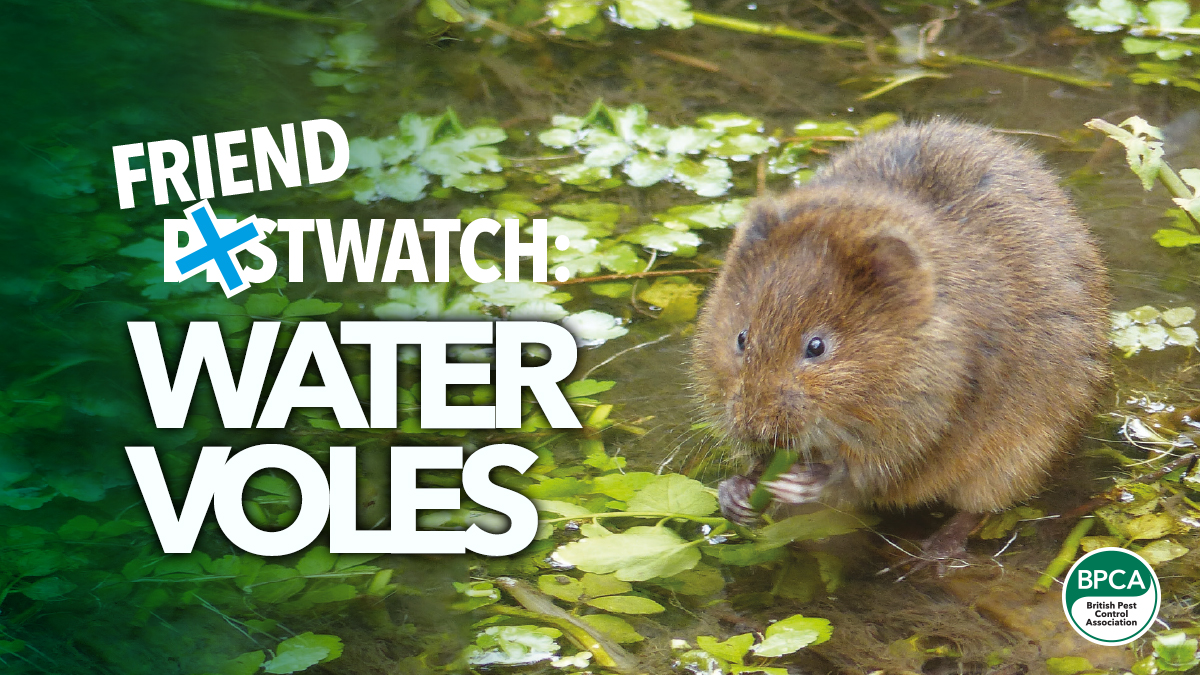
Ratty the water vole
My first memory of learning about water voles was long before I came into pest control when reading children’s book ‘The Wind in the Willows’.
In a classic case of mistaken identity perhaps, you may remember the name of the water vole in that story was, in fact, Ratty.
An important point, since water voles are often mistaken for rats, which can lead to efforts to lethally control them by those who are not familiar with these species and the law that surrounds their protection.
Water voles have undergone one of the most serious declines of any wild mammal in Britain during the 20th century.
Loss and degradation of habitat is one cause, but the most rapid period of decline was during the 1980s and 1990s as invasive American mink spread.
As such, the water vole is a protected species under the Wildlife and Countryside Act 1981 and is a Priority Species under the UK Post-2010 Biodiversity Framework.
Identification: rat vs water vole
Now, to a trained pest professional it is easy to tell them apart and recognise the signs of these different species.
Unlike the brown rat, water voles are herbivores and often leave bits of chewed vegetation by the water’s edge, as they like to sit and eat in the same place.
Another key difference between the rat and the water vole is that the former are most active at night, whereas the latter primarily during the day.
When disturbed, the water vole also makes a characteristic “plopping” sound as it dives into the water.
If you can get a closer look, then they are very easy to tell apart.
This is the time of year that we may see water voles appearing, as their breeding season is typically March to October.
Females can produce up to five litters per year, although the average is usually about two. They can have anywhere between two to eight young per litter.
Young water voles leave their mother at about 28 days old and (if born in the summer months, around July) they could breed that autumn. However, most will not reach sexual maturity until after winter.
Young water voles need to weigh at least 170g to survive the winter months.
Habitat
Where will you find water voles? Well, the obvious answer is anywhere there is water.
There are some cases of water voles living nowhere near water, but their habitat is mainly in the grassy banks of slower moving rivers, streams, lakes and canals. We even have some in our local park which has a disused canal running through it.
Water voles do not hibernate but they do tend to stay in their burrows in the winter months, with other members of their colony.
The Scottish water vole has a different heritage than the water voles found in England and Wales, and it also has slightly different protected status.
In England and Wales, the water vole itself is protected, along with anywhere it is using for shelter. In Scotland, only the places in which the water vole shelters have protected status.
What can we do to help protect this wonderful animal and stay on the right side of Johnny Law?
As with all pest management strategies, a risk assessment is crucial.
If you are doing any rodent control near or close to any watercourse, then it’s not optional.
When conducting your survey, ensure you ask plenty of questions regarding the wildlife status of the area and any history of water voles.
Always consider live capture trapping first, so that you can confirm species before you undertake any control programme.
And remember, it’s not just the water vole that is protected in the UK, it’s the areas that they live and take shelter in, so you must ensure that any actions that you take do not interfere with those.
Dos
- Conduct a risk assessment before external baiting near any watercourse
- Use live capture traps to establish the species before a lethal trapping or baiting strategy
- Use baits that can be secured
- Keep your distance! The further away from the water you put your baits the better, leaving at least five metres.
Don’ts
- Don’t assume identification without doing a survey
- Don’t use grain bait anywhere near a watercourse (high risk of spills and more attractive to birds).
Get involved with conservation
Many organisations are trying very hard to keep water voles in our rivers.
There are programmes running up and down the country which are mapping numbers, sites and gathering data on this amazing mammal.
In 2015, People’s Trust for Endangered Species launched a new project to try and coordinate conservation efforts for the water vole in the UK.
The National Water Vole Monitoring Programme (NWVMP) aims to bring together data from several hundred sites to allow the status of this animal to be assessed year-on-year.
ptes.org/get-involved/surveys/countryside-2/national-water-vole-monitoring-programme/
Source: PPC99