Technical | PPC92 September 2018
Affectionately nicknamed the ‘posh pigeon’, Britain’s strangest invasive avian pest seems to be here to stay. These flamboyant rascals aren’t just targeting fruit trees. Chris Davis from Cleankill tells PPC readers all about the danger of ring-necked parakeets making their way into our buildings.

The ring-necked parakeet is now a well-established resident in South London and Kent, and there are many urban myths as to how they became established in Britain. Small colonies were evident in Kent in the late 1960s, although a dramatic rise in their popularity as cage birds meant that there were an estimated 25,000 imported in 1975-2005, and it is easy to see how a few might escape and become established.
The ring-necked parakeet has been found to be surprisingly adaptable to both cold, wet winter and hot summer conditions, and is now one of the most northerly breeding parrot populations in the world.
In autumn and winter, ring-necked parakeets gather at dusk to roost in large ‘pandemoniums’ which may be several thousand strong – a quite incredible sight to witness in the UK! These roosts break up at dawn to disperse and feed, mainly in parks and in and around fruit farms and other farmland, but also in suburban gardens.
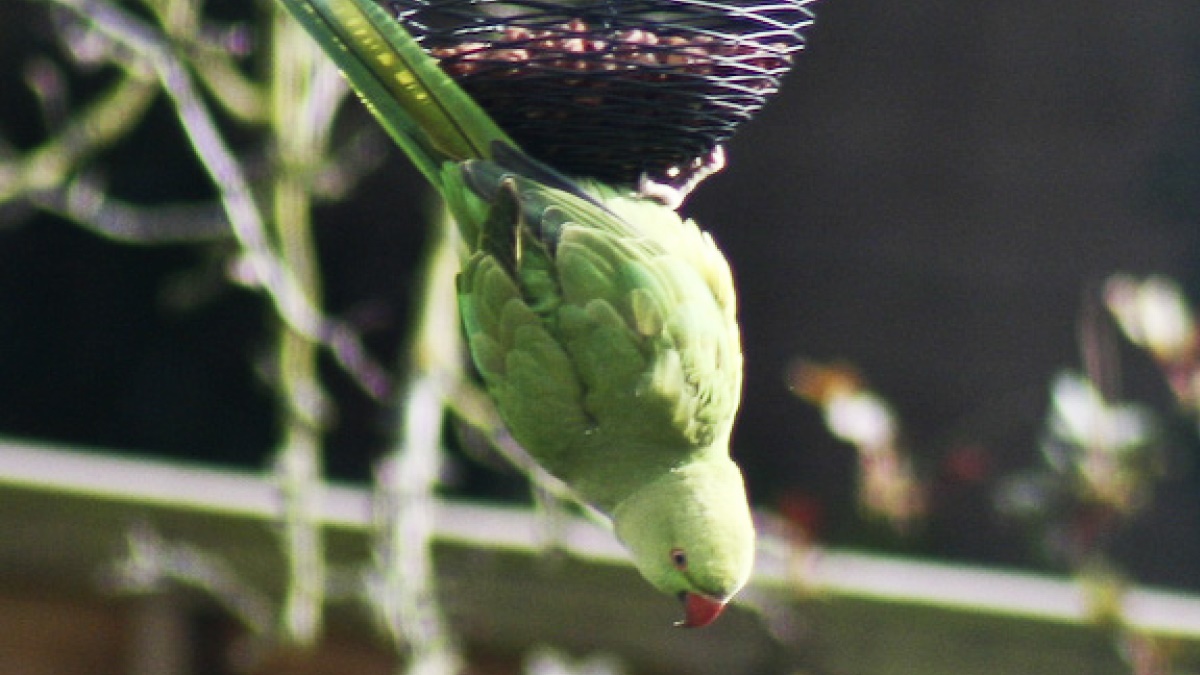
There are a variety of reasons for the success of the ring-necked parakeet. These include:
- They have no natural predators
- They are noisy and aggressive and able to out-compete native species
- They are tough and resilient – able to cope with our weather easily
- They have great longevity – living up to 30 years, and reach sexual maturity at an early age.
It’s estimated that there is an annual increase in London of 30%, but this has tended to be an increase in density of population rather than a wider population spread to other parts of the UK. The estimated range expansion is 0.4km per year, which is relatively slow and steady, but the Gatwick/Crawley area is seen as one of the next potential areas for colonisation.
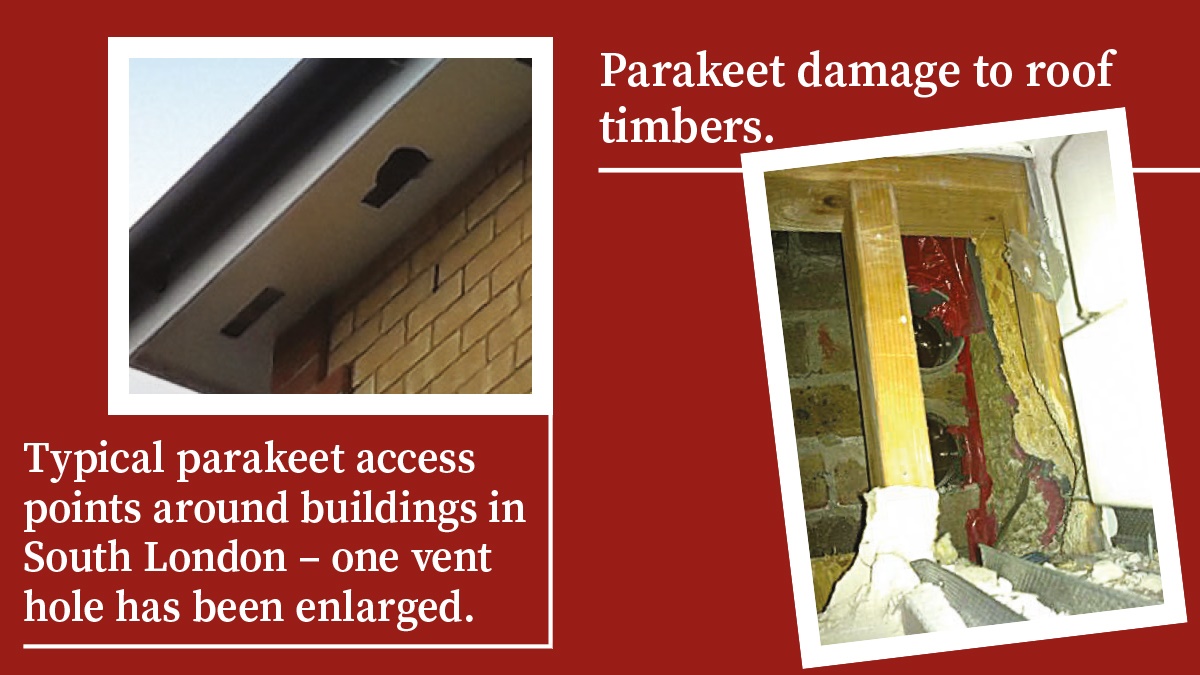
Nesting holes favour those already made by great spotted woodpecker and nuthatch, but here comes the problem: they will also tend to nest in buildings if there are similar-shaped access holes around the building perimeter that they can exploit, or small holes that can be enlarged by their powerful beaks. Once inside a roof space, the damage they can do is quite incredible.
As well as damaging timbers, there is the potential to cut through electrical cabling presenting a potential fire risk. For these reasons, it is strongly recommended that action is taken to deal with parakeet problems in a safe, legal and efficient manner.
Ring-necked parakeets are currently permitted to be killed or controlled under the General Licence WML-GL04 – to prevent serious damage or disease.
The breeding period for ring-necked parakeets is January to June, so proofing work is best done outside of this window to ensure that there are no birds trapped inside a building.
Proofing needs to be extremely sturdy and tightly fitted – if parakeets can get their beaks under an edge of a plastic vent cover or plastic proofing material, they will rip it off. We tend to use 2cm gauge mesh very tightly fitted.
As mentioned above, the birds will often rip off plastic vent covers to gain access to roof spaces or gaps between floors, and in this instance, replacing the plastic cover with a well-fitted metal one may be the answer. However, you need to check the function of the vent, as some vent covers (eg boiler vent covers) can only be replaced by a Gas Safe engineer.
 Chris Davis
Cleankill
September 2018 | PPC92
Source: PPC92