Pest control | PPC91 May 2018
One day I’ll fly away… but until then, we’ll press ahead practising the principles of integrated pest management (IPM) with vigour, says Ralph Izod, Managing Director of BPCA member company Dyno-Pest. Ralph takes the time to explore how IPM is crucial for successfully controlling flying pests and maintaining customer satisfaction.
It’s that time of year when flying insects whir into action with a vengeance. Flies, fruit flies, wasps, mosquitoes, beetles, ladybirds, moths and more make their presence well and truly felt.
Alongside this activity is another army – the social media warriors. Folk who post their videos and messages on YouTube, Facebook, review sites, Twitter etc with the ‘evidence’ that all’s not well with the restaurant, hotel, tourist attraction, factory they’ve visited.
This fuels more unwelcome activity – negative PR in the media.
At the receiving end of this episode marked ‘brand disaster’ is the business owner, the facilities manager, the property managing agent, the landlord – having to justify the ‘why’ and the ‘how’ on a very public platform.
I’m sure my view chimes with other pest management companies when I say that today no business can afford a laissez faire approach to any kind of pest control including that of flying insects. Added to the health, safety and legislation breaches, loss of income, loss of customers and contaminated goods (all the consequence of an untreated or DIY treated infestation) is brand damage. A hard won reputation can be reduced to tatters overnight.
Like all good pest control companies, we practise an integrated approach to effective pest control including flying insects, namely exclusion, restriction and destruction. With IPM as the incontrovertible seam throughout.
Exclusion
Fly screens and strip curtain doors must be fit-for-purpose. A business can tick the box but are they still effective? A significant sum may have been spent on installing these but if they’re not professionally cleaned they become counterproductive.
A classic example being the fly screens in a kitchen which will build up with grease. If not professionally cleaned they’ll attract flies.
Clients assume their maintenance teams have proofing in hand when a technician inspection reveals anything. However, like all good technicians, ours will find those hard-to-locate gaps and cracks. Corrugated roofs can now be repaired with modern proofing materials but it is invariably down to the pest control contractor to point out the need.
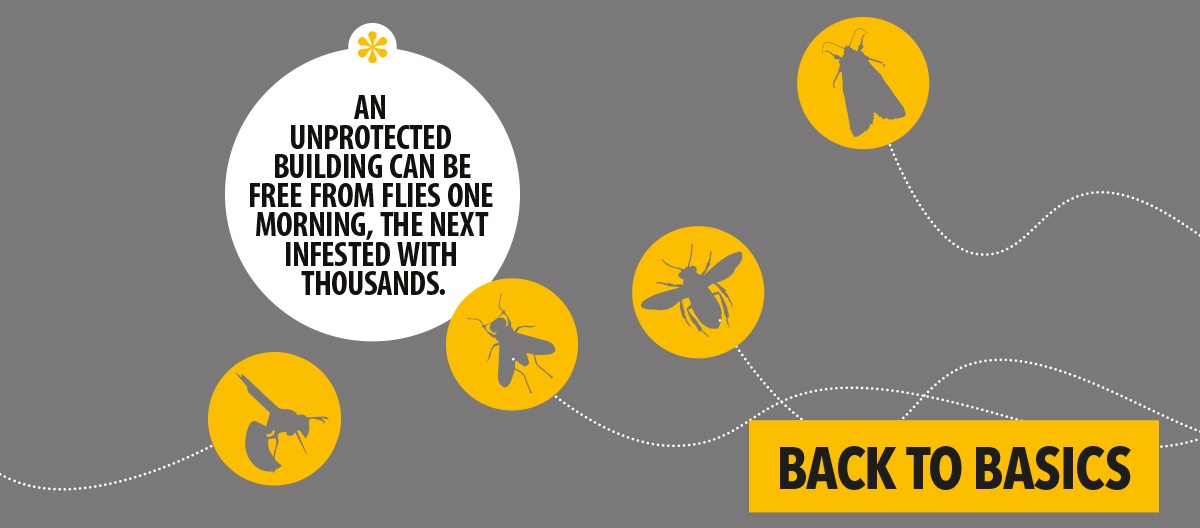
There’s an opportunity to build additional income streams by doing the right thing and letting clients know their insect prevention and exclusion strategies are not doing the job. Without fly screens in place, a business has no defence or control over external factors like an overloaded neighbour’s skip or a broken drain. An unprotected building can be free from flies one morning, the next infested with thousands.
We also explain that while expenditure must be made to exclude flying insects from a building the return on investment is rapid. It only takes one infestation to contaminate products, bring production to a halt and lose key customers as a result.
Restriction
The beauty of IPM is that we automatically look at the bigger picture. This encompasses:
- Undertaking a forensic-style analysis of the local environment to identify hazards that are the source of the problem, such as poorly-managed refuse areas and badly-cleaned, poorly-maintained drains
- Discussing improved cleaning regimes to reduce the ‘fly-appeal’ of the site
- Working with neighbours to manage or eradicate the problem if they are the cause of it – they could also be suffering from the problem and in need of an IPM-based strategy.
- A client reported a problem with flies in a retail outlet. Because they had the measures previously outlined in place, a potential infestation was nipped in the bud. We tracked the problem to a nearby pig farm and our technicians worked with the farmer to significantly reduce the flying insect problem.
Destruction
Modern fly units are powerful and hygienic, as are specialist insect and wasp traps plus pheromone lures and insect growth regulators.
By contrast, old-fashioned fly units are not fit-for-purpose given they throw out the remains of the fly in airborne particles. Regardless of the type, all fly units must be serviced at a rate specified by the technician if they are to remain effective, but how many are?
As we know, if an infestation has really taken hold, more traditional methods have to be used including insecticide sprays and fumigation. Such measures can close a business for hours or days. It is therefore our role as pest control experts to show clients how they can avoid this unwelcome scenario with a robust preventative flying insect exclusion plan in the first place; one that will protect their reputation, their customers and the goods they make, store and distribute.
Try this: ask a business what the financial and reputation cost is for just one day of lost production due to an infestation, then contrast this with the relatively low cost of installing a thorough programme. It helps a business to quickly understand the importance of pest prevention. Far from being a grudge purchase pest control is rightly reclassified as a pivotal business purchase. It’s key to business sustainability.
Want to write something?
We’re always looking for guest writers to submit their ideas for publication. Whether you’re from a BPCA member company or from an associated sector, you could be featured in the PPC magazine. Register your interest:
[email protected]
 Ralph Izod
Managing Director of longstanding BPCA member Dyno-Pest
1 May 2018 | PPC91
Source: PPC91