Ecology | PPC91 May 2018
BPCA’s newest special interest group, Beewise, has been put to work trying to take the sting out of communicating with clients about bees around the home.
As we enter into the end of Spring and beginning of Summer, where the weather is (hopefully) warmer, plants are flowering, and insects begin their mating patterns, a recurring visitor starts her way to find a new nesting site. The humble bumblebee wakes from her winter hibernation and looks for somewhere suitable to set up home.
Most often, bumblebees will set up home in old rodent nests, bird nests or underground hollows. However, one particular species of bumblebee often opts to nest in proximity to humans - the bombus hypnorum (or tree bee). This species first arrived in the UK in Wiltshire back in 2001, and has since moved gradually north, colonising most of the UK. The chosen nesting site of the tree bee is commonly in and around properties, cavity walls, loft spaces, plant pots and other similar cavities, which can bring them closer to humans than many would prefer.
A close cousin of bumblebees is the honeybee. While most commonly found in hives, some honey bees have been found to have colonised cavity walls, chimney stacks, roof cavities and even under floorboards. Around April to June each year honeybee colonies begin mating, creating a new queen who will eventually take the place of her mother within the hive, leaving the old queen to swarm and move on. In an ideal world, these swarms would take up their new residence back in an old hive box – unfortunately this is rarely the case!

Bees are hymenoptera, specialising in flowers, eating nectar for energy and pollen for protein and, as we are all aware, bees of all types remain essential to our ecosystems, being the highest number of pollinating insect. An estimated third of all crops are pollination-dependent, including those used in livestock feed, covering 70 different types of crop. While there are numerous species of bees and pollinators, the two primary species that pest controllers are most likely to come across are bumblebees and honeybees.
While the physical differences between the two may be obvious, the fundamental behavioural and lifecycle differences between the two differ vastly.
Bumblebees are seasonal and do not create and store honey in the same way that honeybees do. Their nests are made of small round waxy cups, where the queen first lays her eggs, then the foragers store pollen and nectar when born. Their numbers are estimated between 50-600 at the end of the Summer. They allow their numbers to dwindle until only the pregnant queen bee survives. She then finds a nesting site to overwinter in emerging the next spring around late March to early April, to begin the process again.
Honeybee numbers are usually around 50,000 per nest at the peak of summer. Living in large colonies allows them to gather considerable resources of nectar and pollen which they then store up to consume over winter, creating the classic honeycomb structure to lay eggs and store food in.
Questions for customers
Members of the public will most commonly come into contact with tree bees and the moment most homeowners will realise they have a nest within their property, will be when mating begins, usually around May each year. Mating behaviours of the tree bee will often be misreported as a constant swarm just outside of the nesting site, where males are hovering for the opportunity to mate with the new virgin queens.
The best way to determine whether or not the customer has a tree bee nest on their property is to ask questions before attending the property to confirm it. Technicians and phone staff can ask customers: “How many bees can you see outside the property?”
If the answer is vague, push for more detail – is it thousands? Or is it below a hundred? This isn’t asking for an exact number. However, if your customer states ‘thousands’ this is more likely to be a honeybee colony or wasp nest depending on the time of year.
Another question to pose is, “Do you see a dancing swarm?” Quite often the mating behaviour of the tree bee can be described as a dancing swarm. Honeybees within the property will not hover on the outside of the entrance to the colony, while tree bee males most definitely will.
_credit_gailhampshire.jpg "Tree Bee, Bombus hypnorum (32848792173) credit gailhampshire")
Ask your customer to send images or video
Quite often the quickest way to determine which species it is to ask your customer to try to snap a photograph or film the activity that they can see.
How can pest controllers protect bees?
When dealing with any bee within a property, technicians should always carry out a thorough site survey and aim to educate their customers on the benefits of bees as pollinators, the behaviour and lifecycle of the bee before taking any further action.
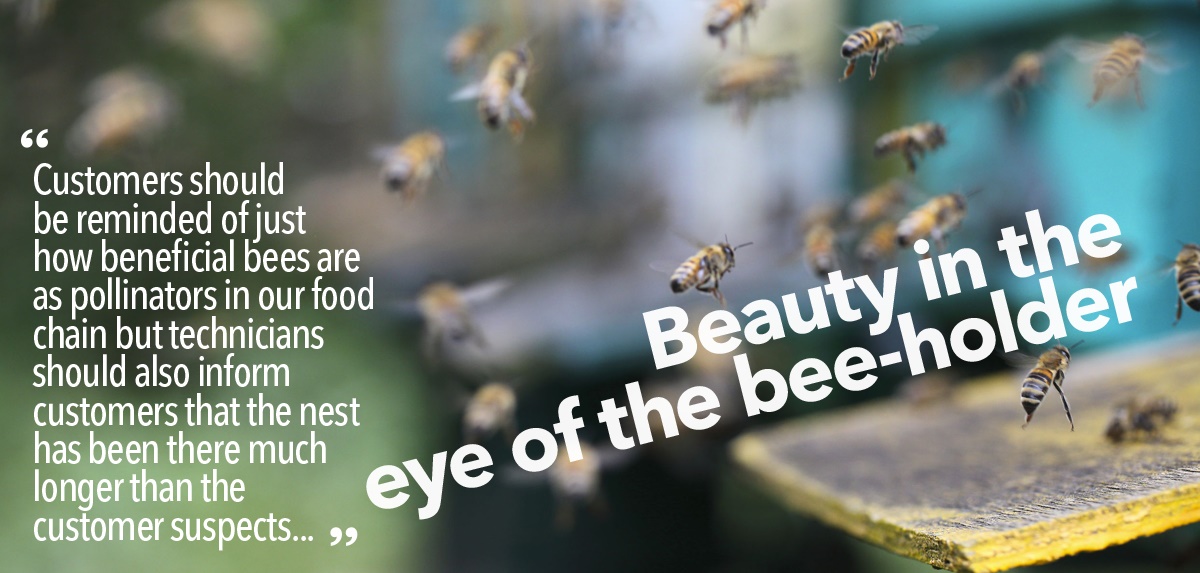
Customers should be reminded of just how beneficial bees are as pollinators in our food chain but technicians should also inform customers that the nest has been there much longer than the customer suspects – usually an entire month or two before they have noticed the mating behaviour. The mating behaviour is also only exhibited by males, who are stingless and therefore pose no threat.

It is recommended to make yourself aware of the HSE’s Wildlife Incident Investigation Scheme, which refers to bees as “beneficial invertebrates” and monitors for the correct use of pesticides while also ensuring that you use any pesticides only after referring to the label. Although, while speaking to numerous technicians at various training events, we quite often find that many refuse to treat bees nests unless in extreme circumstances, while others will try to remove and re-home the colony away from their customer.
The final word from Beewise is if you are unsure at any point when dealing with any bee colony, contact a bee removal specialist who should be able to advise you further or offer to deal with your customer on your behalf.
Code of Best Practice
The Pest Management Alliance has a Code of Best Practice relating to the control of bees which is available to download from the BPCA website.
bpca.org.uk/codes
More advice
British Beekeepers Association
bbka.org.uk
Bumblebee Conservation Trust
bumblebeeconservation.org
National Bee Unit
nationalbeeunit.com
Need a bee removal expert?
Tree Bee Society
[email protected]
01704 894 018
treebee.org.uk/bee-removal
Interested in protecting bees?
Join the BPCA special interest group, Beewise.
[email protected]
Source: PPC91