PPC121 | TECHNICAL
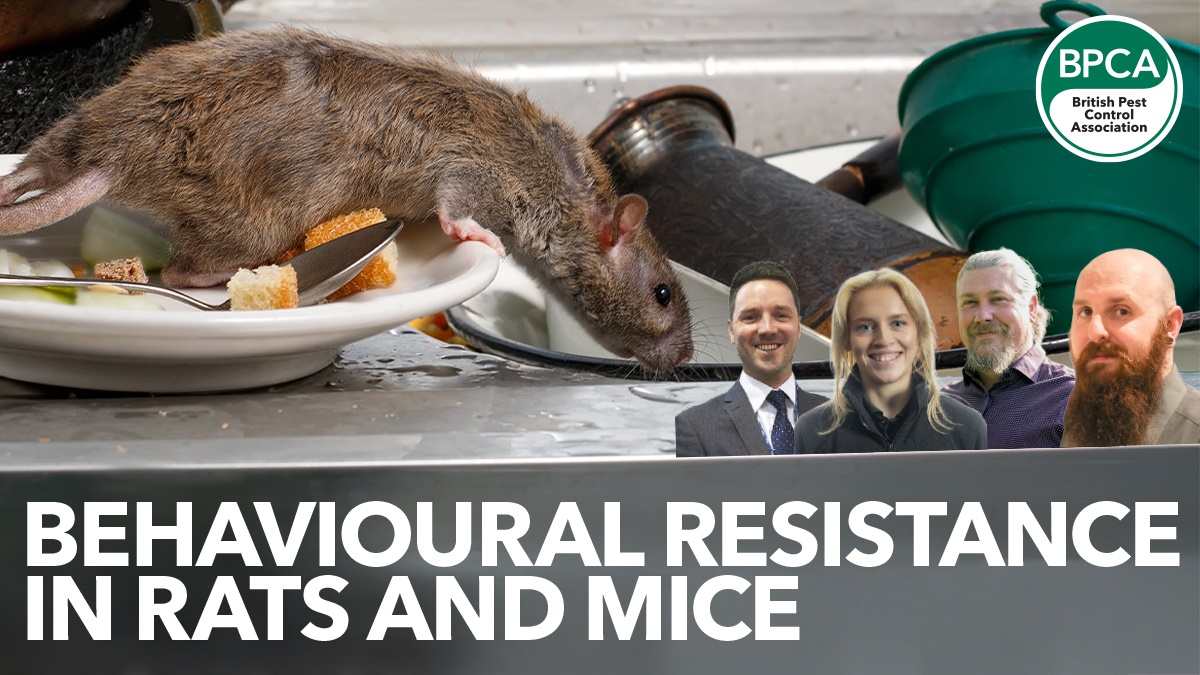
Why do some rodents stroll past bait stations as if they’re invisible? Why do others avoid traps altogether, or develop a taste for one formulation but reject another? Are we tackling super-resistant rodents, or is there a problem with our approach? Behavioural resistance is one of those topics that gets everyone in pest management talking.
The speakers:
Niall Gallagher PPC
BPCA
Alex Wade AW
BASF
Chloe Smith CS
Pest Solutions
Dr Matt Davies MD
Killgerm and RRAG
PPC Let’s start at the beginning. What exactly do we mean by behavioural resistance?
AW It’s any abnormal behaviour that helps a rodent survive where others don’t. It might be inherited or learned, but whether it’s trap shyness, bait aversion or even a preference for a certain food, if it gives them an edge, that’s behavioural resistance. It’s basically their superpower.
MD Exactly. We’ve seen cereal aversion in mice, neophobia in rats, learned aversion where parents pass on avoidance behaviours, and even trap shyness. They’re all part of the same picture.
CS For me, it’s very real. In Glasgow city centre, I see bait box avoidance, trap avoidance and bait preference all the time. It’s not just stubborn rodents; it’s populations that won’t touch what you’re putting down.
PPC How do you tell the difference between resistance and a problem with our technique?
CS My first big shock was moving from rural sites to city centre ones. For me, wax blocks worked great in the countryside. In the city? Nothing. That taught me fast that it wasn’t the bait, it was the mice. These days, I ask clients for hatches into voids and ceilings so I can bait where they’re really moving. Loose bait hidden away often works better than shiny boxes in plain sight.
AW Technology helps, too. With cameras and remote sensors, you can actually see a mouse approach a box, check it out with its whiskers, then choose to walk away. That’s gold. Before, we only had footprints in dust to go on.
PPC Has this always been around, or is it something new?
MD It’s not new. Back in the 1980s, ‘West Midlands mice’ were avoiding cereal-based baits because they lacked enzymes to digest them. That trait passed on through generations. Add in transport networks, and the behaviour spreads far and wide.
AW We’ve been shaping this for millennia. Ever since humans started storing food, rats have been with us. The reckless ones get caught, the cautious ones survive. Over thousands of years, we’ve effectively bred smarter rodents by taking out the dumb ones.
CS And don’t forget DIY treatments. Tenants using weak shop poisons are leaving behind survivors that won’t touch anything by the time a professional arrives.
PPC Is some of what we call resistance just bad pest control?
CS Sometimes. You need to keep changing things up. Different baits, different traps. I’ve had success with tunnel-style traps where mice just run through, and even with unusual lures like crisps or cheese sauce when that’s what they’re already eating. You have to experiment.
AW Exactly. Rats spend very little time feeding. We keep targeting that sliver of behaviour, but there’s a whole pie chart of other behaviours. If they won’t eat, use their locomotion, grooming or nesting habits against them. Find the kryptonite to their superpower.
PPC With glue boards restricted and anticoagulants under review, are we losing too many tools?
AW Any reduction in options makes control harder. Glue boards were niche, but losing enough tools makes the puzzle trickier. Restrictions on anticoagulants would be another blow.
MD That’s why information is critical. Use cameras, monitoring and resistance testing. The more we know, the better we can adapt.
PPC How important is client cooperation?
CS Essential. If a kitchen is filthy, the mice don’t need your bait. Some sites act on recommendations and get results. Others ignore them, and the problems never end. Talk to the cleaners. They usually know more about what’s happening day to day than the managers.
PPC Are new plastic boxes really a problem?
CS I’ll often leave an old box in place if it works. Why risk a shiny new one putting them off?
“Behavioural resistance is a superpower, but every superhero has a kryptonite.” – Alex Wade
AW Research backs that up. Rodents engage less with brand-new plastic than with natural materials. It’s not one single thing; there’s spatial neophobia, object neophobia, even food neophobia. Lumping it all together hides the detail.
CS And bait preferences can vary postcode by postcode. In Glasgow, one area takes one paste, another prefers a different brand. You can’t assume one bait will work everywhere.
PPC Should we be teaching behavioural resistance earlier in training?
CS Absolutely. I learned fast because I was thrown into city centre work. But if you’re rural, you might not see it for years. Awareness should start from day one.
AW My mantra is simple: if this, then that. If plastic fails, try wood. If cereal bait is ignored, use protein. Observe, adapt, repeat. Don’t just blame resistance and keep doing the same thing.
PPC What does the future look like?
AW Every generation thinks it’s the end when tools are taken away. But pests don’t vanish, and neither will we. We’ll adapt. We always do.
MD And remember, information is power. Use the resources out there. RRAG guidance, CRRU testing, CPD opportunities. Stay informed and share data.
CS And don’t forget the basics. Proofing and hygiene aren’t optional extras; they’re the foundation of control.
PPC Final advice for pest professionals?
MD Information is key. Gather evidence, stay updated, and act on what you know.
CS Follow recommendations: proofing and hygiene make all the difference.
AW Behavioural resistance is real, but it’s not an excuse. Observe, monitor, and take away the rodent’s advantage.
Key takeaways
- Behavioural resistance includes avoidance and preferences that help rodents survive
- Technology like cameras and sensors give us new insights into behaviour
- DIY treatments and incomplete control can fuel resistance
- Proofing, hygiene and housekeeping are as important as bait choice
- Adaptation is key: observe behaviours and adjust methods accordingly.
LIKE THIS ARTICLE? WATCH IT BACK
The whole debate is recorded and available on our website! Watch the whole 50-minute discussion there. bpca.org.uk/cpd-videos (login required)
Source: