PPC121 | TECHNICAL
At PPC Live 2025 in Harrogate, a small group of pest professionals gathered around a table to tackle one of the most deceptively simple tools in the pest controller’s kit: the break-back trap.
Led by Kunal Puri, Chair of BPCA’s Technical Committee, the conversation soon revealed just how much nuance there is behind something most of us see every day without a second thought.
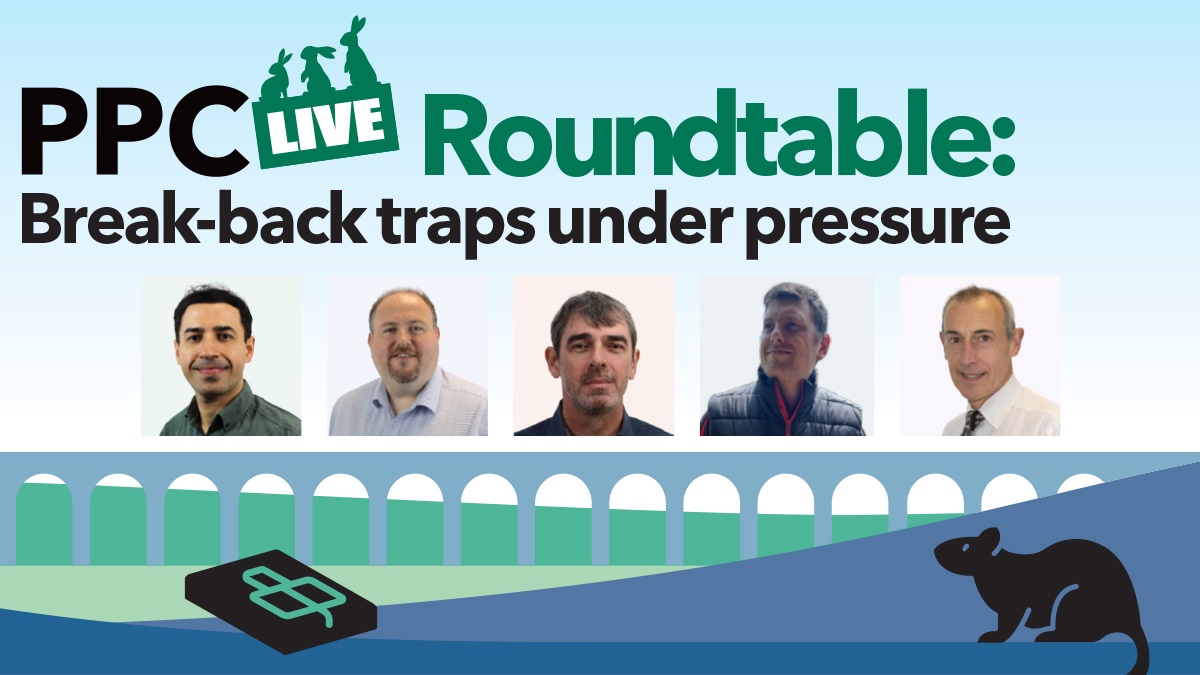
Speakers:
KP: Kunal Puri, BPCA’s Technical Committee, Chair
CC: Chris Cagienard, Pest Solutions
AT: Andrew Tyson, Guardian Pest Management
JW: James Waterhouse, Peledex
MA: Mike Ayers, Precision Pest Management.
KP: Break-back traps are exempt from formal regulation, but that doesn’t mean they’re outside the law. We still have a duty under the Animal Welfare Act 2006 to make sure the animals we catch don’t suffer unnecessarily.
A humane trap should kill at least 80% of target animals within five minutes.
Research by Dr Sandra Baker showed that many commercially available traps failed that test, mainly due to wear in the mechanism. It’s a reminder that even the simplest tools deserve our attention.
AT: Sometimes they’re great, sometimes useless. I work in London, so every site behaves differently. Some rats ignore bait completely; others go for it immediately.
I’ve found that the more you understand the layout and the runs, the better results you get. I use mostly plastic traps these days. They tend to hold up.
CC: Same here. We’ve moved away from wooden traps. They might pass an assessment when they’re new, but after ten uses, they’re falling apart.
The modern plastic ones are far more durable, but not all lures are created equal. Some just don’t attract anything.
AT: I swear by peanut butter and Nutella. Cheap, reliable, and they smell fantastic.
CC: (laughs) We’ve actually had better luck once the traps are “weathered” – a bit of natural scent left on them helps.
KP: That makes sense. Using traps that have already picked up proteins from previous use can be a natural lure. It’s similar to the principle of pre-baiting. That said, neophobia - fear of new objects - is still a real issue, especially with rats. Placement is key.
Placement makes perfect
KP: If you can, use the environment to your advantage. For example, positioning traps in a run where a rodent has to cross them often improves the success of the traps. Just don’t leave traps exposed outdoors – they can pose risks to non-target or protected species.
MA: There’s no welfare benefit to checking traps too frequently either. Once a day is sufficient. The important part is sensible placement and good luring. Directing the animal across the kill bar reduces the risk of foul catches.
CC: Exactly. Technicians also need to think about what’s around the trap. If a rodent hesitates or slows down just before it reaches the trigger, that’s when you get those awkward, inhumane catches.
MA: Behavioural resistance is becoming a bigger challenge too. They’re getting wiser. If they’ve seen traps or felt vibration before, they’ll learn to avoid them.
A question of regulation
KP: The Spring Trap Approval Order first came in back in 1957, and the latest update was in 2018. It governs which traps can be used for wild mammals, like the Fenn and the DOC series, but not break-back traps for rats and mice. That’s where the grey area lies.
JW: If an approval system did come in, it could be complicated. You’d end up with lists saying you can use this trap for house mice but not field mice, even if they’re physically identical.
CC: But if we don’t lead on this, others will. We’ve been here before with glue traps. Animal welfare activists will look at the 20% that don’t die within five minutes and call it cruelty. Manufacturers are unlikely to join voluntarily.
AT: I’d actually buy an approved trap if it existed. At least you’d know it’s been tested and meets the standard.
KP: Agreed. It’s about demonstrating professionalism. We need to show we’re taking welfare seriously, not waiting to be forced into it.
Lessons from glue traps
CC: We could’ve handled glue boards better as an industry. We spent years on the defensive, saying “but we need them,” while the public saw videos of suffering animals. By the time we tried to explain professional use versus misuse, the decision had already been made for us.
If we don’t get ahead of the conversation on break-back traps, we’ll face the same issue again.
KP: Exactly. Professionals should be the ones leading the charge on humane methods. We care about animal welfare as much as anyone else, because it’s part of doing our job properly.
AT: People still buy glue boards online, by the way. I’ve gone into properties and had to explain that using them without a licence is now a criminal offence.
KP: Yes, they’re popping up under names like “rodent blanket”. It’s very hard to control the sale of those imports.
CC: It’s frustrating – the rules change for us, but the same products are still sold online to the public.
“If we don’t get ahead of the conversation on break-back traps, we’ll face the same issue again.”
Traps vs rodenticides
CC: One of the biggest future challenges for our toolkit is the reduction of rodenticides. If regulators or activists then turn their sights on spring traps, we’ll be in serious trouble. That’s why the industry needs to take the lead now.
MA: It’s about smarter use, not necessarily more use. You can get the same outcomes with better trap placement and lure choice. A measured 80% humane-kill rate in under five minutes isn’t just a European benchmark; it’s good practice.
KP: We’ve got to be proactive. That five-minute rule isn’t optional. If an animal isn’t dead within that window, it’s technically illegal under welfare law.
JW: And if we ever reach the point of trap approval, we’ll need proper testing. It can’t be guesswork or marketing claims.
Takeaways
While there were differences in practice and opinion, the room agreed on a few essentials:
Professional responsibility
Pest controllers must use traps that kill humanely and maintain them properly.
Placement and lure choice matter
Site knowledge and experience often make the difference between a clean kill and a foul catch.
Industry leadership
BPCA members want to get ahead of regulation by supporting research and best practice on humane trapping.
The conversation at PPC Live made one thing clear: break-back traps may be simple, but using them properly is anything but.
As one delegate joked on the way out, “Maybe it’s time we gave the old snap trap a bit more respect – after all, it’s still doing the heavy lifting.”
JOIN THE DEBATE
Want to be part of conversations like this? Get registered for PestEx today!
ExCeL, London
18-19-March 2026
REGISTER NOW

Source: PPC121