PRESS RELEASE
BPCA member London Network for Pest Solutions is playing an important role in monitoring one of the planet’s deadliest insects.
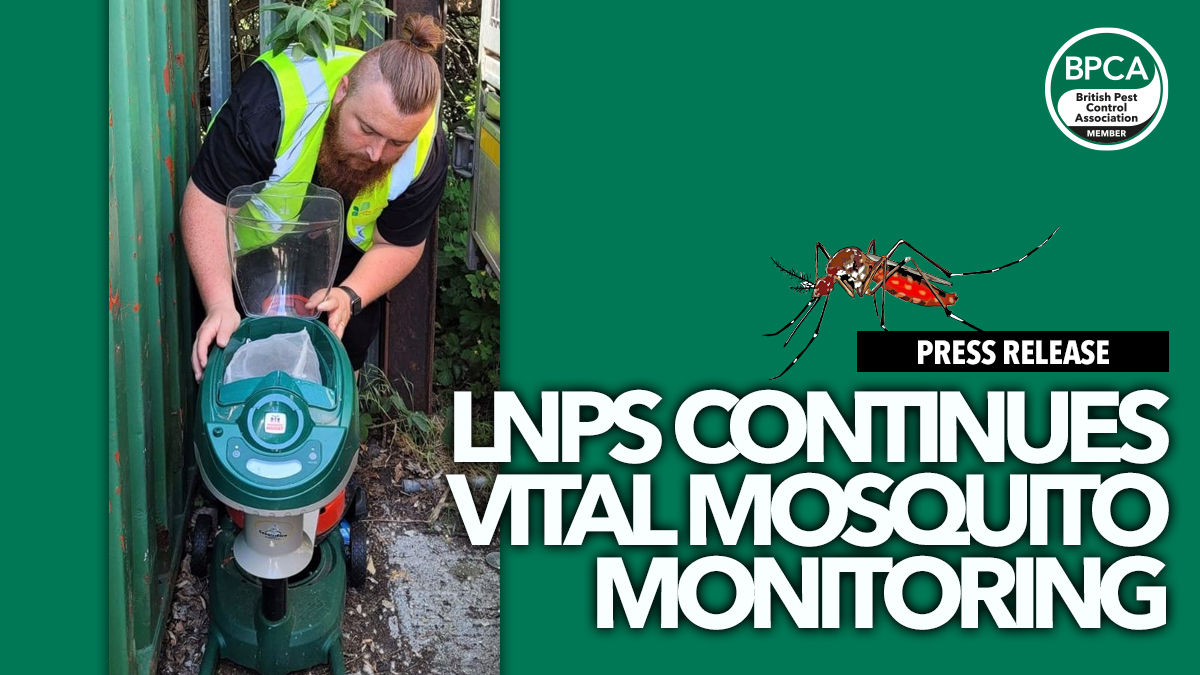
Newham was one of several councils originally asked to help with a vital mosquito monitoring project by Public Health England (PHE).
Newham Council’s pest control team started work on the project several years ago and it has been continued by LNPS - a limited company owned by the London Borough of Newham. LNPS is as part of the Greater London Pest Liaison Group (GLPLG).
The annual survey takes place over a three-month period. A static trap called a mosquito magnet, located in Newham, is used.
How does it work?
The magnet is attached to a propane gas cylinder which gives off a low level of carbon dioxide. Mosquitoes are attracted to the warmth and CO2 given off by humans and by mimicking humans, the mosquitoes are attracted into the unit from many miles away.
They fly into an attached bag where they die because of lack of food – normally human blood.
The trap is run for four days every fortnight. At the end of each run period, LNPS staff check and change the bag and send it to PHE who then physically count and identify each species of mosquito caught. This is done around the UK and then once a year a report is produced.
World's biggest killer
LNPS Managing Director Paul Cooper said: “I am so pleased that LNPS has continued the work started by LBN. It is far more important than people realise.
"It is an often forgotten fact that mosquitoes kill far more humans each year than any other creature. Figures vary but it is generally accepted by the WHO that mosquitoes are responsible for about three quarters of a million deaths worldwide each year.
“There are lots of mosquito solutions on the market, from personal wrist bands, small spray repellents, mosquito nets, noise emitters and the larger UVL machines but, as always, the best method of protecting yourself against mosquitoes is to ensure you remove any sources of standing water.
"That is where you can easily see their larvae. The standing water does not have to be big or deep, anything is suitable such as old tyres or unused plant pots."
Public Health England (PHE) runs the nationwide mosquito surveillance project in collaboration with a range of organisations across the country. The project aims to develop and update our understanding of the status, distribution and abundance of these potential endemic vector species.
Millions of years in the making
Mosquitoes are responsible for transmitting serious diseases such as malaria. With no vaccine currently available, malaria — an ancient disease that began afflicting humans from the beginning of agriculture and modern civilization — remains a deadly threat to people around the world.
Caused by Plasmodium parasites, malaria shows up in historic texts as far back as the first millennium BCE. In fact, the first traces of malaria parasites were found in mosquito remains that are over 30 million years old.
...the first traces of malaria parasites were found in mosquito remains that are over 30 million years old.
Malaria's probable arrival in Rome in the first century AD was a turning point in European history. From the African rain forest, the disease most likely travelled down the Nile to the Mediterranean, then spread east to the Fertile Crescent, and north to Greece. Greek traders and colonists brought it to Italy.
Malaria has affected every continent except Antarctica, and remains a widespread problem in parts of the world including Sub-Saharan Africa, South Asia, and the Caribbean. Over 200 million people still contract malaria each year. In 2010, 90% of malaria deaths occurred in Africa.
Although its chief sufferers today are the poor of sub-Saharan Africa, Asia, the Amazon basin, and other tropical regions, 40 percent of the world's population still lives in areas where malaria is transmitted.
BEEN UPTO MUCH?
Let us know what's going on at your pest control company and we might include it on our website or in our magazine.
[email protected]
Source: LNPS press release