PPC122 | TECHNICAL
In rural and agricultural societies, firearms have long been essential tools for protecting crops and livestock from damage caused by various animals, including rodents, birds, and in some places around the world, even large predators, like wolves and coyotes.
Well, bonus: we don’t have to worry about coyotes in the UK. But if you're new to the world of controlling pests with guns, you do have to think about a wide variety of things like training, the law, gun models and calibres.
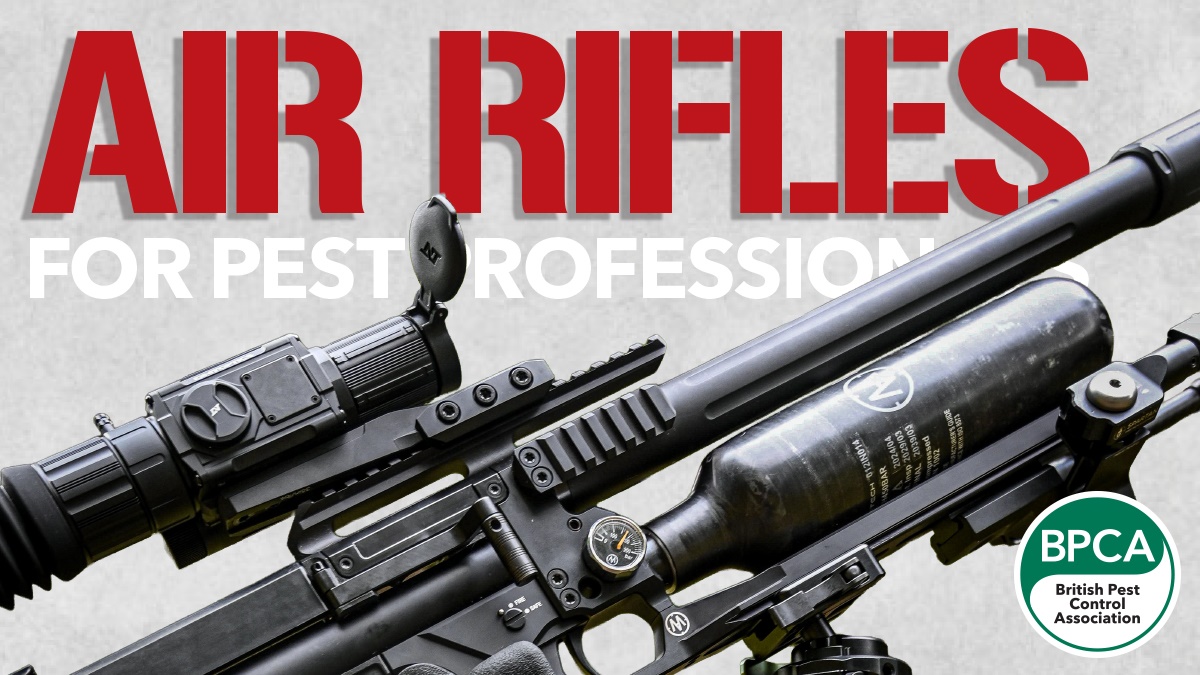
It's never been a better time to add shooting to your pest control toolkit. Modern rifles are efficient, accurate and supported by a wide range of accessories. When used correctly, they can be an effective, non-toxic tool within an integrated pest management plan.
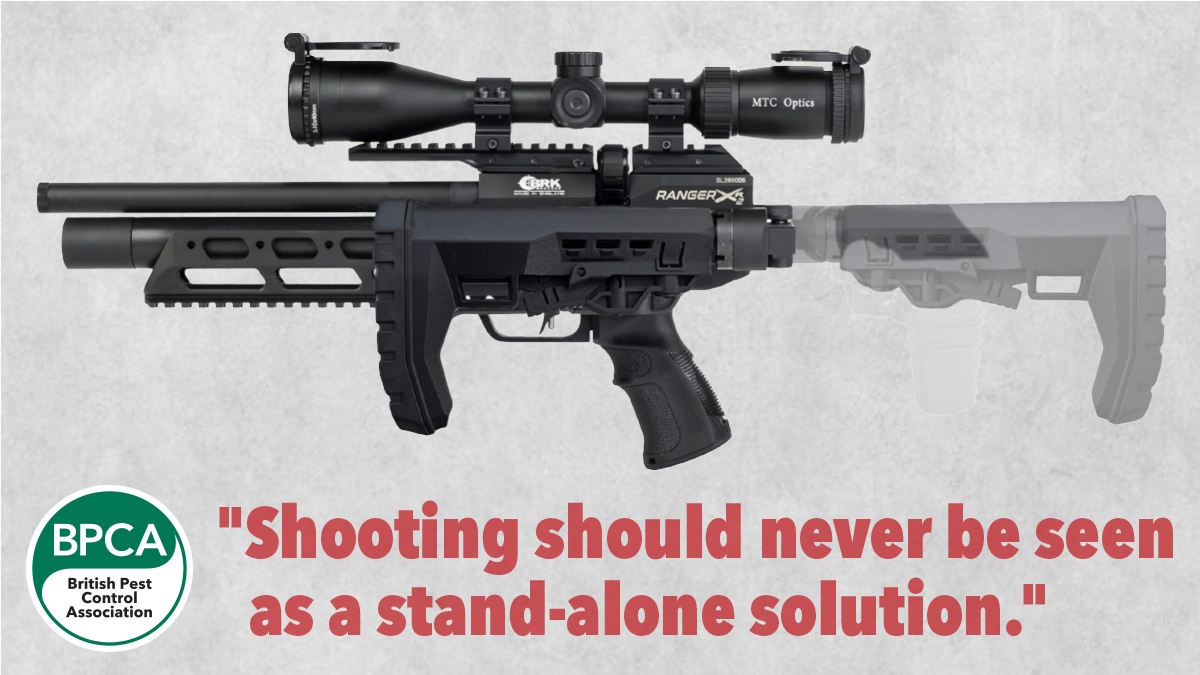
Shooting should never be seen as a stand‑alone solution. It must sit within a wider programme of inspection, proofing, housekeeping and monitoring.
This article gives an overview of the main types of air rifles, how different calibres perform, what the law says and how to build competence if rifles form part of your work.
Knowing UK law
You must understand the law before you buy, hold or use an air rifle. Even though air rifles are different from full firearms, they are still regulated in a similar way in the UK.
If you break the law, you risk large fines and prison. It can also affect your future ability to work under the General Licence.
Laws differ between England, Wales, Scotland and Northern Ireland. If your work takes you across borders, you need to stay up to date with each legal framework in the devolved nations.
The following legislation is particularly important:
The main principles in those apply across the UK.
General licences for bird control change often, and in January 2026 illuminated devices were once more allowed under General Licence GL41, for the purpose of managing feral pigeons for public health.
This may change again in the future. It is your responsibility to check the latest version before undertaking work.
Police forces and wildlife licensing bodies publish updates throughout the year. Keep a record of the versions you use and check them regularly.
You must also:
- Know the current legal power limits
- Store and transport your rifle safely
- Understand your obligations under wildlife licences
- Know when you can shoot and when you cannot.
The three main rifle types
There are three common types of air rifle used in pest management. All can be effective if used within the law and with good technique.
The right choice depends on your budget, how and where you work, and how much time you can spend developing your skills.
Spring powered rifles
Spring powered rifles are often the first rifles used by new technicians. They are usually the most affordable option and they do not need extra equipment such as pumps or dive bottles.
When you fire a spring rifle, the internal spring compresses and then expands quickly. This can cause recoil, vibration and movement inside the rifle.
These forces can make accuracy more challenging, particularly for new shooters.
Shooting a spring rifle well takes practice. You need to develop a consistent grip, body position and follow through. It can also take time to learn the best pellets for your rifle.
Maintenance is simple if you follow the manufacturer’s guidance. Many technicians learn to strip, clean and tune their spring rifles with support from online guides and forums.
If you make changes yourself, always stay within legal power limits and keep notes of any work done.
Spring rifles can be harder for people with limited strength or mobility because cocking the rifle takes effort. Some models can be adapted, but you should always check the manufacturer’s advice before modifying equipment.
Gas ram rifles
Gas ram rifles work in a similar way to spring rifles.
The difference is that the spring is replaced with a sealed gas cylinder. When you cock the rifle, you compress the gas rather than a coil spring.
This design gives a smoother firing cycle with less vibration. Many technicians find gas ram rifles easier to shoot accurately.
They are also less tiring to cock and can offer consistent performance over long sessions.
Gas ram rifles are a good option for people who want the simplicity of a spring system with a little more comfort and control.
Pre-charged pneumatic rifles
Pre-charged pneumatic (PCP) rifles store compressed air in a built-in reservoir.
You fill this reservoir with a hand pump, a compressor or a dive bottle. The rifle then releases a small amount of air with each shot.
PCP rifles have very little recoil. This makes them easier to shoot accurately, even for people with limited wrist or shoulder strength. PCP rifles come in two main types:
A regulated rifle uses a valve system to ensure that each shot receives an equal amount of air. This improves consistency and can make long range shooting easier, while unregulated rifles experience a power drop as pressure decreases.
PCP rifles can be more expensive, especially when you include the cost of filling equipment. They also need more checks and seals tend to wear over time.
However, many technicians prefer them because they are quiet, accurate and reliable.
Choosing a calibre
Most pest management work uses either .177 or .22 calibre pellets. Other options, such as .25, exist but are less common.
Trajectory and range
A .177 pellet is about 4.5mm in diameter and a .22 pellet is about 5.5mm. This difference affects how the pellets behave.
Because .177 pellets are lighter, they travel faster and drop less over typical air rifle distances. This flatter flight path means you have to adjust your aim less often.
It is one reason why .177 is popular for target shooting and training.
The slower .22 pellet has a more curved trajectory. This means you must estimate distance more accurately.
Once you know your rifle well, this becomes easier, but it does take practice.
Pellet design also plays a role. Common shapes include domed, hollow point, pointed and wadcutter.
Choose a design suited to your role and always test to find which performs best in your rifle.
Effective range depends on your skill, your rifle and the pellet. Many technicians are comfortable shooting out to 20–30 metres once they have trained regularly and know their equipment.
You should only shoot at distances where you can place every pellet accurately in the vital area.
Energy on target
Under UK law, all air rifles with a muzzle energy over 12 foot pounds would be classed as a firearm.
At equal power levels:
- .177 delivers speed and accuracy
- .22 delivers more momentum and often better energy transfer.
For pest management, energy delivery matters.
A .22 pellet can offer an advantage when dealing with small mammals and robust birds because it transfers more energy into the target.
However, no calibre can make up for poor shot placement. A humane shot relies on precision first, then on choosing a suitable pellet.
Wind behaviour
Wind affects pellets differently. The lighter the pellet, the more it will drift. Good technique can overcome both issues.
You should test your rifle outdoors in different conditions so you understand how your pellets react.
Which calibre to choose
There is no single right answer. Many technicians use both calibres depending on the job.
Choose .177 if you want:
- A flatter trajectory
- Ease of training
- Precision work where distance varies.
Choose .22 if you want:
- Better energy on impact
- Work on rabbits, squirrels or pigeons at sensible distances
- A pellet that handles wind a little better.
Ditch the carrots,illuminated devices are back
Illuminated devices help you work in low light or darkness. Common options include:
- Torches
- Scopes with illuminated reticles
- Night vision
- Thermal imaging equipment.
These devices can make shooting safer by helping you identify species and judge body position. However, they can also create risks if used without training.
Lamping
Lamping means using a high powered light to detect and identify animals. The light can be handheld, attached to the rifle or fixed to a vehicle.
Light can reflect from objects such as glass, metal or even dew. Sometimes these reflections look like the eye shine of an animal. You must always confirm the species before you shoot.
If a target is partly hidden in shade or vegetation, you may see only a glint of reflected light. Move to a better angle, lower the light or switch to a filter.
Never shoot without full identification.
Infrared night vision
Infrared night vision uses ambient light and an infrared torch to improve visibility. Animals usually cannot see this light.
Night vision is useful but has limitations. Reflective surfaces can still mimic eye shine.
Judging distance can be harder than in daylight. This can lead to poor shot placement if you are not experienced.
Practice with your device and learn how your pellets behave in low light.
Thermal imaging
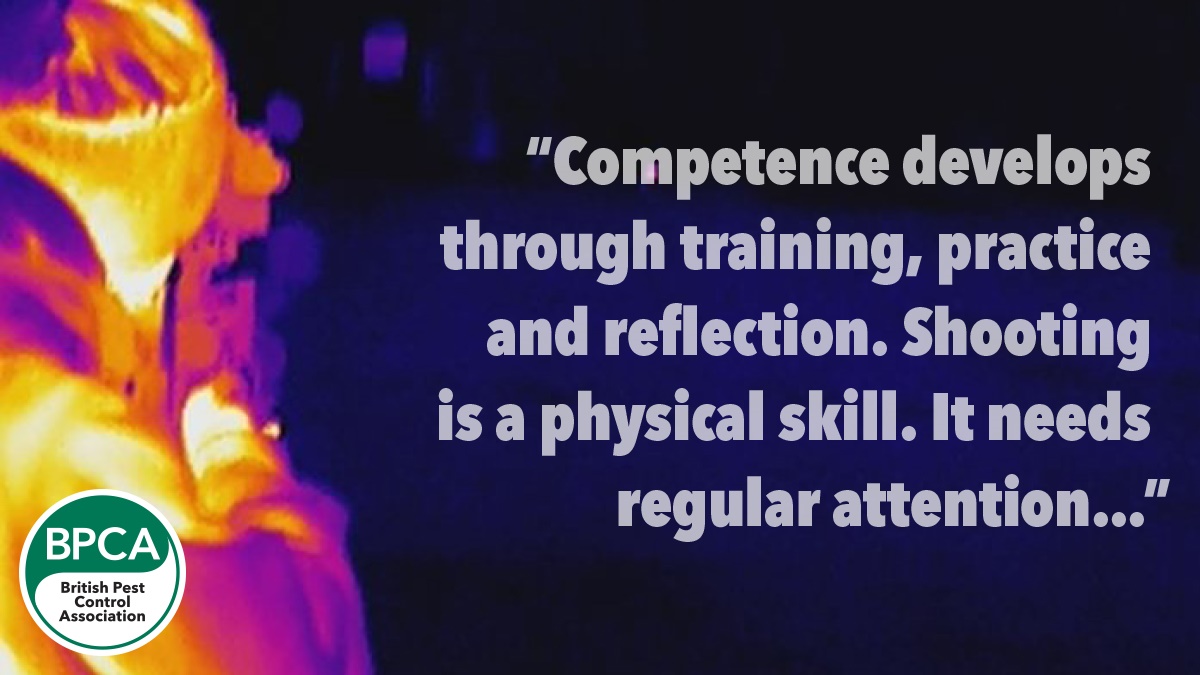
Thermal imaging equipment detects heat rather than visible light. It works day or night.
Thermal imaging is excellent for detection. It can quickly confirm whether pests are present.
However, it is weaker for identification. You may need a second device, such as a lamp or night vision scope, to confirm species before you shoot.
Never rely on heat signatures alone to identify your quarry.
Training and building competence
Competence develops through training, practice and reflection. Shooting is a physical skill. It needs regular attention to stay consistent.
Good training includes:
- Safe handling and storage
- Pellet selection and testing
- Zeroing your rifle at sensible distances
- Understanding how wind and weather affect shots
- Practising from realistic positions.
Shooting ranges are ideal places to build confidence.
Many technicians train with colleagues or join local clubs. Group sessions can help you share knowledge and improve faster.
You should keep a record of your training, including dates, distances and pellet types.
This helps you learn what works best for you and your equipment, and can also be recorded as CPD.
Shoot safe
Air rifles can play a valuable role in pest management when used safely and legally.
The right rifle is one you can shoot accurately and confidently.
Whether you choose a spring, gas ram or PCP model, regular training and a clear understanding of the law will keep you, your clients and wildlife safe.
WildWise
Special thanks to the WildWise special interest group for providing some images and expertise for this article.
Source: