PPC122 | TECHNICAL
Niall Gallagher, Technical Manager at BPCA, shares practical insight on one of the most challenging bird species facing pest professionals today. Niall explores gull identification, licensing, behaviour and the practical realities of managing gulls legally and effectively as we head towards the 2026 season.
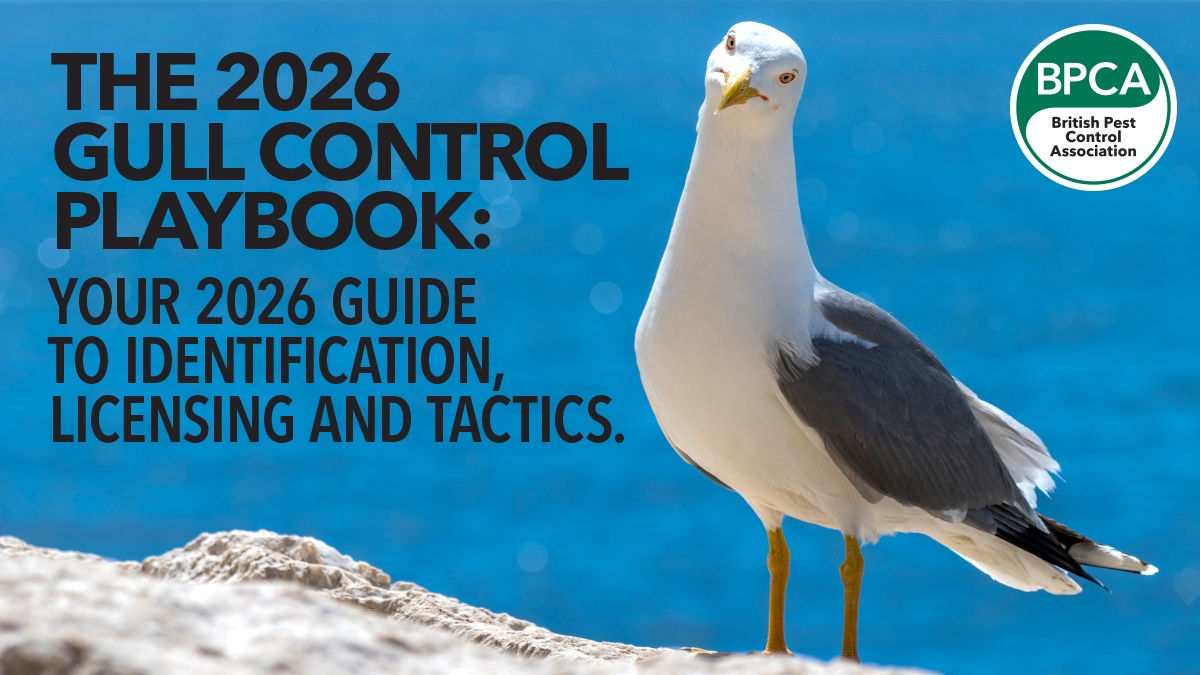
I’ll be honest from the outset: gulls are not the easiest species to work with. They’re protected, highly adaptable, increasingly urban and, when nesting, can be downright confrontational.
Add licensing complexity and public scrutiny into the mix, and it’s easy to see why so many pest professionals approach gull work with caution. That’s exactly why we need to get better at it.
What follows isn’t theory for theory’s sake. It’s how I approach gull management in practice: understanding the law, reading bird behaviour properly, planning work at the right time of year and building programmes that stand up to scrutiny.
Understanding licensing before you touch a site
Everything starts with licensing. If you get this wrong, nothing else matters.
In England, most gull-related work sits under class licences or individual licences issued by Natural England.
These licences tell you exactly what species you can act on, why you can act, when you can act and how you can act. They’re not suggestions. They are conditions.
You must always check the current version before carrying out work. If you’re relying on last year’s wording, you’re already on shaky ground.
Blessed are the scribes
Record keeping is where many people fall down. But it’s one of the most important things you do and will be your saving grace if you find yourself in a spot of bother with authorities.
You must document:
- All alternative lawful methods tried first
- Why those methods were not satisfactory
- Why your proposed action is reasonable and proportionate
- The species involved, using the scientific name
- Dates, locations and methods used.
These records should be kept for at least three years. If Natural England (or local wildlife licensing body) asks for them, you need to produce them quickly and confidently.
Good digital reporting makes this far easier than trying to reconstruct events months later.
Knowing your gulls matters more than you think
“Seagull” isn’t a species. It’s a catch-all term that causes no end of problems when it appears in reports or licence applications.
In the UK, we regularly encounter around a dozen gull species. Each has different behaviours, conservation status and legal implications. Misidentification can undermine an entire control programme.
I don’t pretend gull ID is easy. I don’t have a natural knack for it.
What helps is breaking identification down into manageable features:
- Leg colour
- Beak colour and markings
- Size and wingspan
- Back and wing shading
- Seasonal plumage changes
- Vocalisations.
Conservation status is another factor you must understand. Some species are amber or red-listed in the UK despite being classed as ‘least concern’ globally.
That distinction matters because licensing decisions increasingly lean on UK population data. We are seeing overall declines in several gull populations. That doesn’t remove the need for management, but it does mean scrutiny is increasing.
The better your evidence and justification, the smoother your licensing process will be.
Squawk this way: Audio is often overlooked as a method of identifying gull species, but their calls are surprisingly distinct. If you can recognise them, it adds another layer of confidence to your survey work.
Bird pressure is not uniform across a site
One of the biggest mistakes I see is treating a site as if bird pressure is the same everywhere. It rarely is.
I break bird pressure down into light, medium, and heavy, but those pressures can coexist across a single site.
A roof may have heavy nesting pressure, a courtyard medium loafing pressure and a façade only occasional use.
Understanding that allows you to design targeted solutions rather than blanket measures.
Surveys are critical here. Desk-based reviews using mapping tools are useful, but nothing replaces a proper on-site assessment.
Drones can help on complex roofs, but only if you understand what you’re looking for.
Colour-coding pressure zones on site plans can be incredibly effective when explaining issues to clients. It turns a vague “we’ve got a gull problem” into a clear, evidence-led discussion.
Timing is everything
If there’s one message I try to drum home, it’s this: gull work is won or lost in winter.
From roughly September through to February, you have the greatest opportunity to intervene without running into nesting restrictions. As soon as you move into March, things become far more complicated.
Even early nest-building counts. A couple of twigs on a roof can legally constitute a nest. Miss that window and your options narrow rapidly.
Gulls typically:
- Return from wintering grounds in late winter
- Establish territories in early spring
- Lay eggs from late April
- Hatch chicks through May and June
- Fledge in July
- Disperse from August onwards.
This lifecycle should dictate your management plan. When clients call in July demanding immediate action, your winter recommendations suddenly make a lot more sense. Planning ahead avoids panic-led decisions later.
Integrated pest management applies to gulls too
IPM isn’t just for rodents and insects. The principles apply just as strongly to birds. You need to look beyond the building itself. Gulls will travel kilometres to feed. Ask why your site is attractive compared to those around it.
Key factors include:
- Building design and sheltered features
- Waste management and food availability
- Human behaviour
- Nearby redevelopment or displacement
- Seasonal changes in food sources.
Early involvement in building design can save clients huge amounts of money. Bird deterrence built into new developments is far more effective and far cheaper than retrofitting later.
Waste management is often the simplest win. Open bins, overflowing containers and poor cleaning regimes will undermine even the best deterrent systems.
Deterrents, proofing and realism
No deterrent works forever on its own. Audio systems can work well for gulls, although noise concerns must be considered.
Visual deterrents often have limited long-term effect, but they still have a place, particularly when demonstrating that alternatives have been tried.
Hawking and dog work can be highly effective as part of a wider programme, especially to prevent establishment rather than react to it. Used in isolation, their impact is usually short-lived.
Proofing remains one of the most reliable long-term solutions, provided it is designed and installed correctly.
Netting must be fit for purpose, properly tensioned and regularly inspected. Poor netting creates welfare issues and reputational risk for the entire industry.
Spiking needs careful specification. Not all spikes are suitable for gulls. Length, angle and placement matter. This is where working closely with knowledgeable manufacturers and distributors pays dividends.
And don’t be fooled into thinking that photographs, measurements and detailed plans are admin for admin’s sake. They protect you and demonstrate professionalism.
Control options and licensing reality
Egg oiling, pricking or removal can be effective population management tools if your licence allows for the use of them. They are not quick fixes and should be presented as part of a longer-term strategy.
Lethal control sits firmly behind individual licensing and must be supported by strong evidence.
Licensing officers are making decisions without seeing the site. The quality of your application determines the outcome.
Incomplete or vague applications are the most common reason for refusal.If you’re unsure, ask for help. We would much rather support you upfront than see you struggle through enforcement action later.
We have documents and articles on applying for licences, so get in touch and we can guide you through it.
Data, evidence and the future
One thing I’m increasingly passionate about is data. Surveys, nest counts, population trends, and site records all matter.
National datasets are often incomplete and rely heavily on volunteer reporting. Industry data can help paint a more accurate picture of urban gull populations.
If we want proportionate regulation in the future, we need evidence to support it.
That’s why groups like the BirdWise Special Interest Group exist. They bring together industry expertise and external stakeholders to promote best practice and defend sensible, welfare-led bird management.
We work closely with regulators not to block change, but to shape it in a way that protects public health, animal welfare and professional standards.
If you fancy observing a meeting or joining the group, just let me know: technical@bpca.org.uk or learn more at bpca.org.uk/groups
Final thoughts
Gulls are not going away. Urban populations will continue to test buildings, businesses and patience.
Our job is not to promise miracle cures. It’s to provide honest, lawful and effective management based on evidence and good planning.
If you take one thing from this article, let it be this: the best gull control work starts months before the first complaint comes in.
Plan early. Record everything. Know your species. And don’t be afraid to ask for support.
WANT TO WATCH BACK THE FULL WEBINAR?
Members can watch Niall’s webinar and hundreds of other videos at bpca.org.uk/cpd-videos (login required)
Source: