PESTWATCH
A team of experts representing 42 organisations across the UK and Europe have identified raccoons as being among 20 species most likely to become invasive in Britain over the next decade.
A horizon-scanning exercise conducted for the UK’s Non-Native Species Secretariat (NNSS) studied 145 different species.
The raccoon, or Procyon lotor, is the only vertebrate on the list, and retains its top 20 spot from an earlier exercise in 2019.
Do raccoons pose a risk?
Raccoons are carriers of diseases and parasites including rabies, canine distemper, toxoplasmosis and mange.
Transmission of Baylisascaris procyonis, (commonly known as raccoon roundworm) is a major cause for concern.
The parasite causes severe human disease, and more than 90 species of wild and domestic animals have been identified as being infected with this roundworm which puts children and pets at particular risk.
Found in dogs, rodents, foxes and weasels, raccoon roundworm has been known to cause a fatal central nervous system disease in commercial chickens, pheasants and rabbits.
As omnivores, raccoons will eat small mammals, eggs, chicks and adult birds especially seabirds and waterfowl, as well as berries, nuts, seeds, crayfish, crabs, amphibians and insects – adapting readily to available food sources.
They can have a severe impact on native endangered species through predation but also eat field and garden crops – in the United States around 25% of commercial crop damage by wildlife is thought to be caused by raccoons.
In urban areas, household rubbish is an easy food source. And as excellent climbers, raccoons can cause damage to roofs, insulation and chimneys as lofts and attics are ideal resting places.
Are raccoons already present in the UK?
While there is not believed to be a breeding population of raccoons in Britain, escaped pets or runaways from private collections can thrive for around four years in the wild.
Native to Northern and Central America, raccoons were imported into Germany in the 1930s and rapidly became established across Central Europe including Poland, France, Luxembourg, the Netherlands, Belgium, Switzerland, Austria and Hungary.
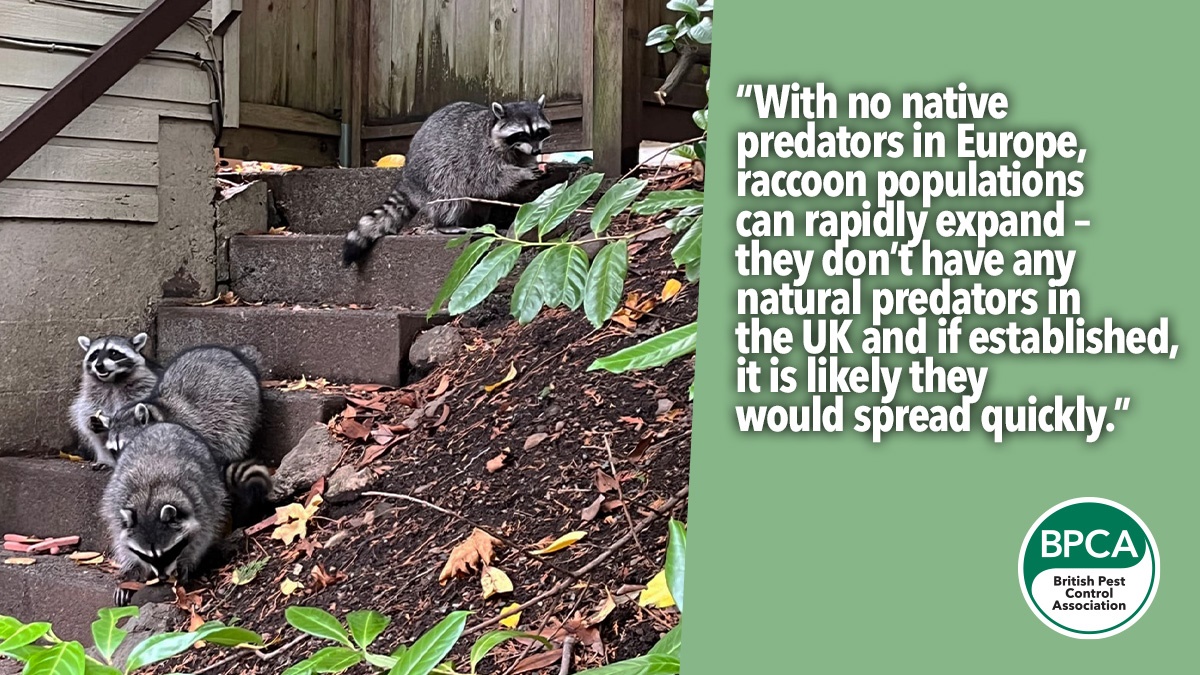
With no native predators in Europe, raccoon populations can rapidly expand – they don’t have any natural predators in the UK and if established, it is likely they would spread quickly.
The first recorded sighting in the UK was in Brecon in 1977. Just 34 raccoons were observed out of captivity up to May 2006, with more than 20 sightings in England and Scotland recorded between 2014 and 2024.
Their preferred habitat includes woodland near water, but as excellent swimmers and climbers, raccoons are adaptable and are known to thrive in urban areas in Europe.
Why do I need to know about raccoons?
As with many potentially invasive non-native species, BPCA keeps a watching brief to ensure our members are aware of possible pest issues arising and so we can prepare if it seems likely a new species is becoming established in the UK.
While sightings are rare, raccoons are a Species of Special Concern and an NNSS alert species. Raccoons outside captivity should be reported to the secretariat.
In the past BPCA and our members have been called upon to help identify species of all kinds. If a client believes they’ve seen a raccoon, get as many details as you can and signpost them to the NNSS.
A map of raccoon sightings can be found at: species.nbnatlas.org/species/NHMSYS0021109776
Source: Online