TECHNICAL | PPC109 October 2022
Ahoy there!
Professor Stephen Harris has studied British mammals for nearly 60 years. His interest in ship rats began in the 1970s when, as a student at Bristol University, he obtained specimens of ship rats from Avonmouth Docks. He then went on to study their impact in other parts of the world.

Trying to establish the status of ship rats in Britain is surprisingly difficult. In 2018, for instance, The Mammal Society published an article declaring that, “It is believed that the black [ship] rat has a population of zero in the UK now but it cannot be considered extinct here until an exhaustive survey has been conducted”.
In Ireland, none were reported from the mainland between 2010 and 2015, although there is a long-standing population on the island of Lambay off the east coast.
While there were a few records for the UK mainland between 2000 and 2009, some of these may have been due to misidentification.
The problem is that this information is based on reports from naturalists, who rarely have access to ports, dock areas and other sites where ship rats are most likely to be encountered, so the paucity of records is unsurprising.
Last century, changes in the status of ship rats were monitored using questionnaire surveys of port health and local authorities, and records provided by pest control experts, the very people who are most likely to encounter ship rats. These consistently identified a number of ports and coastal infestations, with the occasional inland population.
Identifying black/ship rats: It is not always obvious when you see a black (ship) rat. The key differences are the larger ears and longer tail compared to a Norway rat. Black (ship) rats come in different colours, and you are more likely to encounter one of the brown colour varieties in Britain.
The British Pest Control Association organised an online survey in early September 2022, asking whether any members had encountered a ship rat infestation, where it was, and how long ago.
Most infestations were still in docks and ports, with the population at Tilbury featuring regularly (10 reports). Other infestations were at Southampton (3 reports), with one each for Belfast, Felixstowe, Folkestone, Glasgow, Immingham, Ipswich, London, Manchester and Plymouth. Inland populations of ship rats were reported from Hamilton, Huntingdon, Llanynys (north Wales), Newmarket, Norwich and Wakefield, in County Mayo in the west of Ireland, and domestic premises on the island of Sark.
Despite the widespread perception that ship rats are nearing extinction in Britain and Ireland, there are still a number of established, and temporary, populations. The one at Tilbury, for instance, has been reported a number of times over the last 40 years, although it is unclear whether it was present continuously throughout this period or re-established by new arrivals via port shipping.
Unfortunately, since there is no central repository of information, it is hard to establish how often ship rats are introduced to Britain and Ireland, how frequently they are moved around the country, and how long these infestations persist.
To fill this gap in our knowledge, it would be really valuable if pest control professionals could send any ship rat records (and common rat and house mouse records, which are also under-reported) to The Mammal Society’s recording scheme. It is quick and easy to do – please download the app from mammal.org.uk/volunteering/mammal-mapper
I am extremely grateful to Scott Johnstone for organising the online survey, Dr Pat Morris for supplying photos, Dr Alan Buckle for insightful discussions, and to all the people who contributed to the survey.
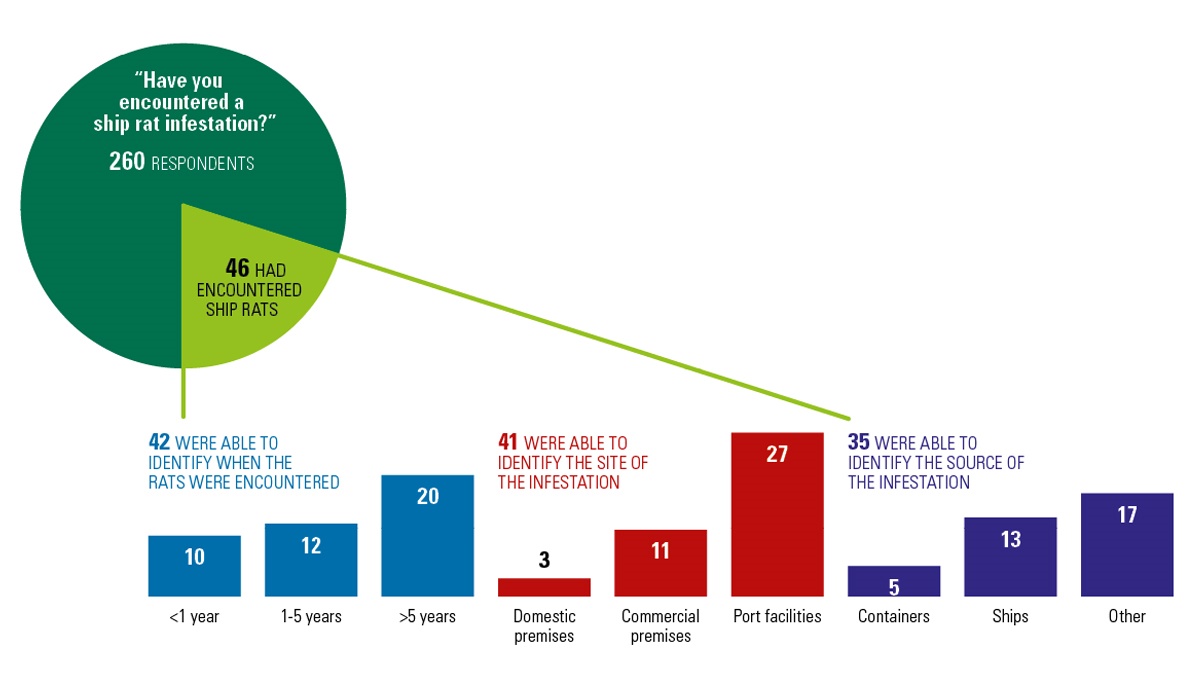
Source: PPC109