CHEMICAL REGULATION
UPDATED 27 February 2026.
Earlier this month, the Health and Safety Executive (HSE) published their plans for reforms to post-Brexit chemical regulations, and on Tuesday, the Department for Work and Pensions (DWP) introduced draft legislation that would start to implement them. Many of BPCA’s proposals have been adopted, resulting in potential administrative savings for biocide manufacturers and encouraging innovation in the pest management sector.
SPEED READ:
- HSE reforms adopt several key BPCA recommendations, with a number now before Parliament
- EU biocide approvals to be recognised, reducing duplication
- Authorisation fees could fall by up to 97%, easing costs
- 173 substance expiry dates delayed; risk-based call-in proposed
- CLP notification requirements set to be removed, cutting admin burdens.
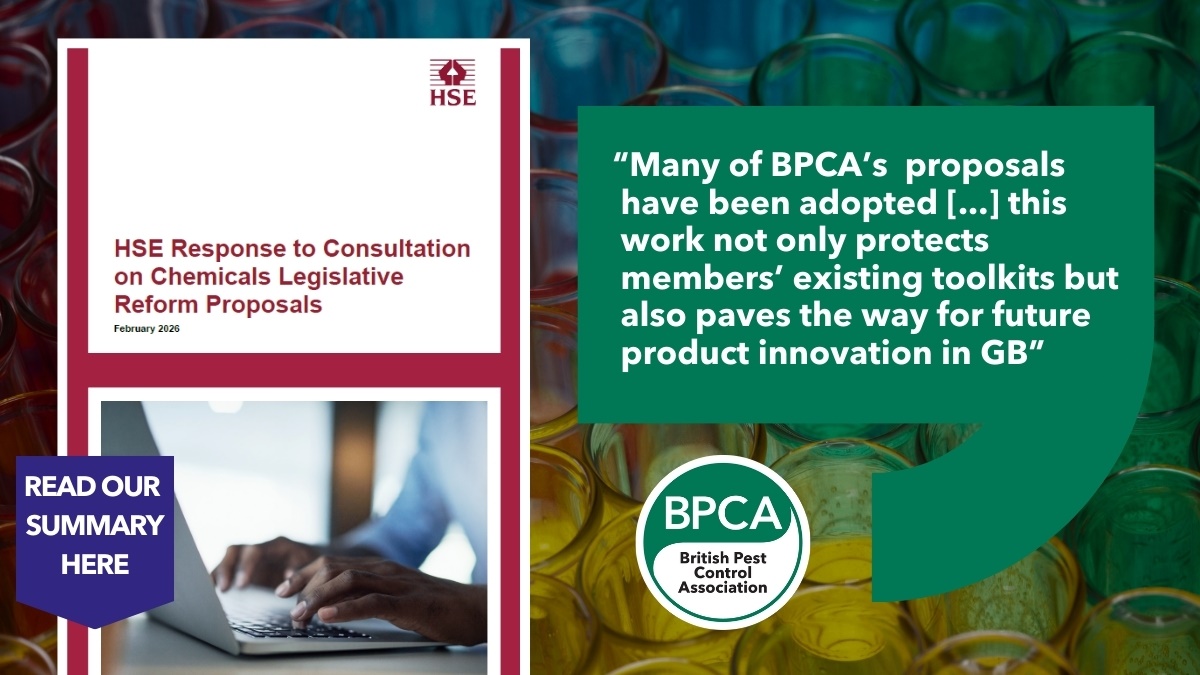
Last summer, HSE conducted a consultation on proposed changes to various chemical regulations inherited from the European Union following Brexit.
These included the Biocidal Products Regulation (GB BPR); Classification, Labelling and Packaging (GB CLP); and Prior Informed Consent (GB PIC), which governs the import and export of certain chemicals.
BPCA submitted a detailed proposal on the back of HSE’s consultation, which seems to have been well received. HSE, in its report, recognises the importance of biocides, which are essential to society for controlling pests and protecting public health and infrastructure.
On Tuesday evening, the DWP published a draft of The Chemicals (Health and Safety) (Amendment, Consequential and Transitional Provision) Regulations 2026, which would give effect to many of the HSE’s plans.
What changes has HSE proposed?
Proposals related to GB BPR (which regulates our products, including rodenticides, insecticides, repellents and active substances they contain) are focused on reducing HSE workloads and business costs.
| Proposal area |
What’s changing |
Why it matters to the sector |
BPCA position |
| GB BPR – recognition of EU approvals |
HSE to recognise EU biocide approvals in Great Britain |
Cuts duplication, reduces fees and speeds up access to products |
Supported |
| GB BPR – expiry dates replaced |
Move towards a risk-based call-in system |
Gives short-term certainty and could create a more proportionate review system |
Cautiously supported, with concerns raised |
| GB CLP – notification requirements |
Removal of routine supplier notifications to HSE |
Reduces administrative burden while retaining safety information on request |
Supported |
Recognising foreign jurisdictions
This included the possibility of recognising approvals in foreign jurisdictions, which BPCA supported. HSE plans to recognise only EU approvals.
HSE believes that such a move would help reduce their backlog of 330 substance and product approvals inherited from the EU and lower the fees they charge businesses.
They estimated that the authorisations for substances costs could be reduced by 97%, from an estimated £160,000 to £4,800; and for products by 96-99%, from an estimated £25,000 to between £250 and £1,000.
Those cost estimates would only cover seeking authorisations in Great Britain. The greatest benefit would be the ability to obtain authorisation in the EU and access the British market, without the need to duplicate administrative processes and pay additional fees.
BPCA hopes these proposals will help keep pest management products financially viable in Great Britain (GB) and avoid further toolkit losses.
Call-in system rather than expiration dates
Also proposed was the removal of substance and product expiration dates to be replaced with a risk-based call-in system.
BPCA cautiously supports the principle but questions how decisions on when to call in a substance or product for review will be made, what data will be required from industry, and the timeframe for making these decisions.
Combined with the recognition of approvals of foreign jurisdictions, now just the EU, BPCA argued that foreign restrictions could be one of the scenarios where a call-in within GB is triggered, with companies able to apply for approval within just GB.
HSE has agreed with our concerns and stated that further consultation would be needed on the call-in proposal, but appears to support BPCA’s position that companies should be able to apply for authorisation in GB even when they have been restricted in the EU.
To give time for such a consultation and any subsequent legislation to progress, HSE intends to postpone the expiry dates of 173 substances from January 2027 for 5 years.
Reduced Classification, Labelling and Packaging (CLP) administration
BPCA is also pleased to see that HSE has recognised and accepted our feedback on changes to GB CLP.
Currently, suppliers are required to notify HSE with up-to-date information on their products, including classification of hazardous properties and their labelling.
The proposals would remove that requirement, making it unnecessary for HSE to maintain a database of that information.
Such changes to GB CLP form part of the government’s commitment to cut administrative costs for businesses by 25% by mid-2029. The savings with this proposal come from the time saved submitting notifications to HSE. However, suppliers will still need to be able to produce information for a given product upon request.
Next steps and legislation
On Tuesday evening, the DWP published a draft of The Chemicals (Health and Safety) (Amendment, Consequential and Transitional Provision) Regulations 2026, which would give effect to many of the HSE’s plans.
Included in these draft regulations were changes to:
| GB Biocidal Products Regulation |
GB Classification, Labelling and Packaging Regulation |
GB Prior Informed Consent Regulation |
|
The expiry dates of 173 active substances will be extended until 31 July 2031.
These are substances for which renewals have already been applied for, but where the current approval would have expired before a decision on renewal could be taken.
|
The notification requirements on suppliers will be removed.
HSE will therefore no longer need to establish a public database of notifications.
|
The additional conditions placed on only certain chemicals for waivers will be removed.
Waivers on the usual requirement for exporters of chemicals to have the explicit consent of the importing country will be issued with the same conditions for all chemicals.
|
|
Updates to essential use/critical situation permits.
Unauthorised biocidal products that are necessary for controlling dangers to public or animal health, or the environment, where this is no alternative can remain available in Great Britian for either:
- up to 550 days; or
- until the product is authorised in cases where continued need is unlikely to be temporary.
|
Technical guidance notes for substances on the GB Mandatory Classification and Labelling list will be moved to the HSE website.
|
Removal of a requirement for exporters of small quantities of chemicals for research or analysis to obtain and include in their export declaration a Special Reference Identification Number
|
|
Ensures that all approved active substances will see improved data protection periods and end dates.
|
|
|
Other changes that affect the administration of chemical regulation by HSE, reducing their workloads, are also included in these draft regulations.
DWP estimates that these draft regulations could save businesses significant sums:
- Extension of active substance expiry dates could save affected manufacturers £25 million a year in otherwise lost profits
- Administrative savings of £34,000 from removing the GB CLP notification requirement and database
As secondary legislation, it will require the approval of both Houses of Parliament before it can take effect, but it will progress much faster than primary legislation, such as Acts of Parliament.
Many of the other changes proposed by HSE are not included in these draft regulations and will require Acts of Parliament, particularly for changes to GB BPR, such as the recognition of foreign jurisdictions and the new risk-based call-in system.
This means that while we have a general understanding of where regulation of our toolkit will go, many details remain to be decided and will be set out in further consultations and Parliamentary scrutiny.
Rosina Robson, BPCA Chief Executive, reflected on the reform proposals, saying:
“BPCA is pleased to see efforts from the regulator and government to address the issues identified in our manifesto, where post-Brexit regulations have imposed high costs on businesses, stifling investment in new products.
“The actual level of savings will depend on how the required legislation progresses through Parliament and may not be reflected until the next general election.
“Ultimately, this work not only protects members’ existing toolkits but also paves the way for future product innovation in Great Britain.
“BPCA will continue to meet with HSE and lobby for better chemical regulation that leads to innovation in the pest management industry”.

Source: