In this guest blog, Mark Butler and Martin Rose-King ask if the pest management advice you're getting on the internet is legit.
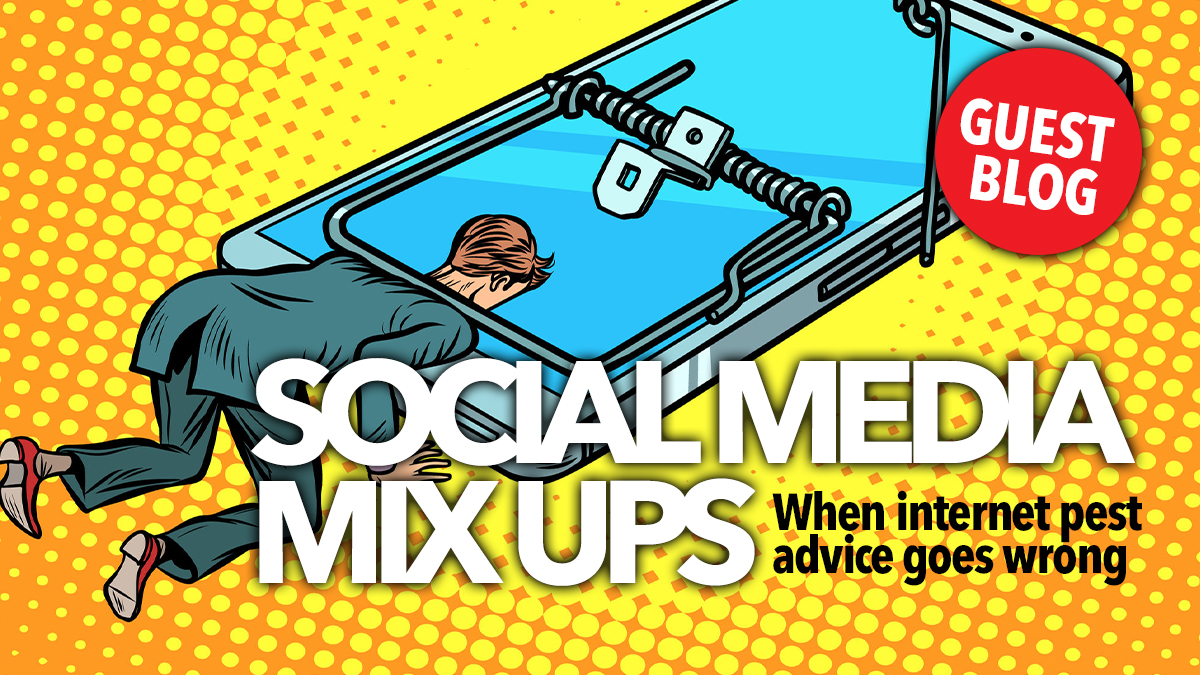
We've all been there: an urgent call from a customer panicking about the ‘deadly’ bug they have just found, needing you to visit and ‘fumigate’ immediately so that a worldwide infestation is prevented.
So what do you do?
Will you ask for a picture or will you visit to identify the pest? Or will you charge into the property with every insecticide available and cover the premises from top to bottom, just in case?
Of course, the professional pest controller will do a thorough survey before proceeding; as we all know, it is illegal to treat with pesticide without positive identification of a pest.
But what if you can’t identify the pest? Anxiety strikes.
You don’t want to appear unprofessional in front of your customer.
Then an idea comes to your mind: the internet!
"I’m just nipping to my van!" you say, hastily heading off with your smart phone in hand.
A quick Google search reveals you have a mutant insect on your hands, capable of wiping out humankind within days.
You scroll further, as that can’t be the answer.
The next image looks promising, apart from the fact that the insect is only found in the jungles of Borneo.
Time’s running out and you can only spend so long pretending to organise your paperwork.
Then it hits you - the Facebook group!
Sorting the wheat from the chaff
Now, before proceeding, it is important to note that in ‘that Facebook group’ there are some very knowledgeable people, all of whom will volunteer hours of their free time to identify pests, give advice and help others in their quest to learn more about pest control.
I admire this small group of people, as I have witnessed some truly remarkable offers of help.
However, do you really know who is giving you the advice? Are they qualified? Are they competent? Is what they suggest legal?
What if you get advice from someone who is just making an educated (or otherwise) guess? And this is where it can all go horribly wrong.
If you are somebody who enjoys the banter of these online groups but doesn’t use them for serious advice, then you have no need to worry.
Do you really know who is giving you the advice? Are they qualified? Are they competent? Is what they suggest legal?
However, it's much easier than we care to admit for information we read on the internet to make its way into our knowledge base, whether consciously or by accident.
So a few pointers for you, before concluding that you have found the solution:
- Not all advice is coming from people based in the UK or familiar with our laws – we viewed one recent posting which quite bizarrely and illegally advised the technician concerned to SHOOT a feral cat that was reported as regularly wandering into hospital wards
- Information can sometimes come from unreliable sources, such as one online survey that advised to 'follow the label as closely as possible’. This contradicts the actual law, that you must adhere to the label completely
- Question what you read and factcheck it using other resources
- If you have one, use your BPCA BPM manual
- Most suppliers offer a huge amount of high quality technical support for free these days - ask the manufacturer if you have any questions
- BPCA and NPTA both offer masses of support to their members, and have qualified and experienced staff to do so.
Getting advice from these sources will allow you an element of technical back up that can make you look a lot better and more professional than your competitors, and you will be learning from your experience as well.
Our industry is packed full of professionals who take pride in their work, continue to keep updated with relevant CPD and training, and mentor others so that they can also become professionals.
In our opinion, our industry has never been so rich with talent and is being transformed in the eyes of the public.
Those that carry these values should be proud of their efforts. It is up to us as a professional industry to point those starting their careers, young or old, in the right direction for the correct advice.
Facebook groups and online forums have their place but always remember to check the truthfulness and legality of any advice given on these platforms.
GOT SOMETHING TO SAY?
If you would like to write a guest blog for the BPCA website, let us know.
[email protected]

Source: Online