PESTAWARE
Bin collections have a key role to play in protecting people from the dangers of pest infestation, say experts at a national trade body.
British Pest Control Association (BPCA) is urging householders to prepare to deal with household waste themselves if kerbside collections are disrupted.
In recent weeks, strike action by refuse collectors has been reported in the West Midlands, South Gloucestershire, Canterbury, Bristol and Somerset.
Natalie Bungay, Technical Manager at BPCA said: “Any disruption to bin collections is a concern, as overflowing wheelie bins and black bags full of rubbish are a playground for pests, particularly rats, flies and wasps.
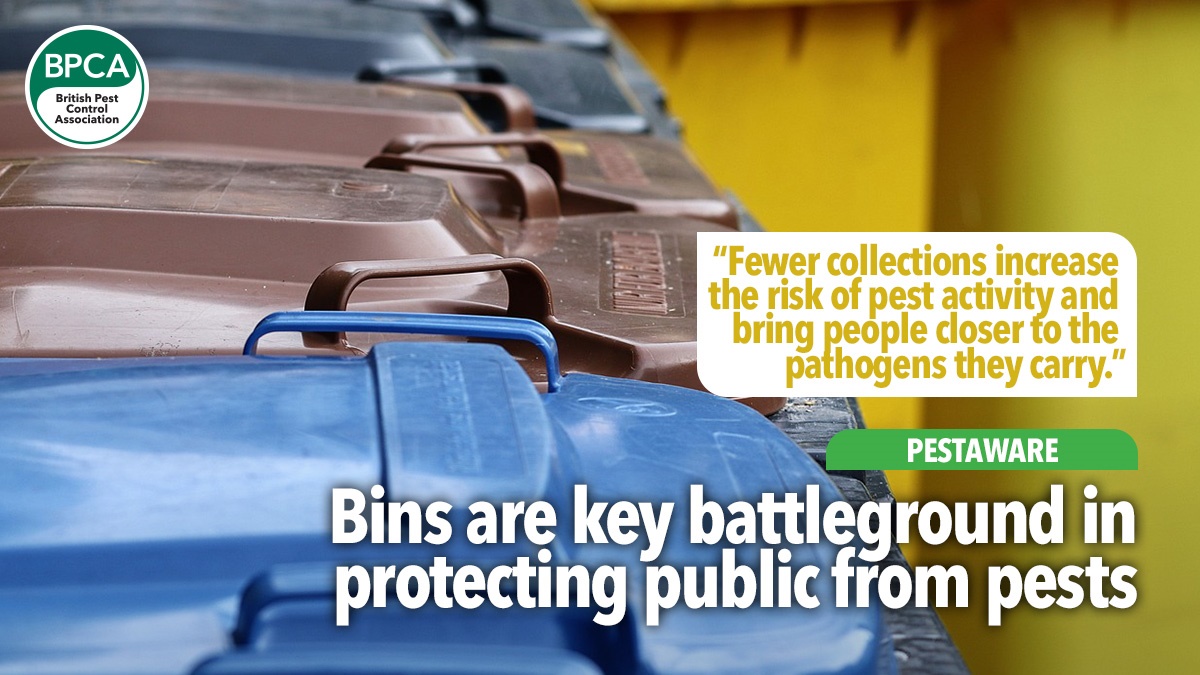
“Fewer collections increase the risk of pest activity and bring people closer to the pathogens they carry.
“Bins should be kept relatively clean and have securely-fitting lids that are kept completely closed.
“If there is disruption to bin collections, we would encourage householders to consider taking additional steps such as taking household waste to their local tip and recyclables to the appropriate venue.
“While it might not be a pleasant or easy task, it could prevent infestation issues further down the line.”
While rats are usually more likely to be an issue in autumn and winter, when they are on the hunt for warm, dry shelter with access to a food source, household waste and scraps are an attractive food source at any time of year, and one they will quickly take advantage of.
Rubbish that isn’t disposed of properly can also attract flies, which use decaying organic materials as a food source and breeding ground – and in warm weather, this can quickly lead to a bin or bin bag full of maggots.
Worker wasps will also be attracted to rotting fruit, which can cause them to become inebriated and, in some cases, more aggressive.
A wasp sting can trigger anaphylaxis, an allergic reaction that can be fatal. If you suspect anaphylaxis, dial 999 and ask for an ambulance.
If there is disruption to bin collections, we would encourage householders to consider taking additional steps such as taking household waste to their local tip and recyclables to the appropriate venue.
BPCA is pointing householders looking for help and advice to its online A-Z of Pests, a series of guides full of helpful tips: bpca.org.uk/A-Z
Natalie added: “If pests are attracted by uncollected household waste, they might well find harbourage nearby and settle down to breed. And pest species are often able to reproduce very quickly!
“For example, female rats can reproduce every six weeks. On average they will produce litters of six to eight offspring each time, which means a rat infestation can quickly grow out of control.
“If the presence of pests – or a serious infestation – is identified, we always recommend seeking help and advice from a pest professional such as a BPCA member, to tackle the problem.”
A BPCA member company will have the technical knowledge and experience to apply products in an efficient manner while minimising risk to the environment and non-target species.
BPCA members:
- Carry the correct insurances
- Are trained and qualified technicians
- Are assessed to the British Standard in pest management EN 16636
- Follow BPCA’s Codes of Best Practice.
To find a BPCA member visit: bpca.org.uk/find.

Source: Online