REGULATION
The European Chemicals Agency (ECHA) now considers mechanical traps suitable alternatives to anticoagulants for controlling indoor mice infestations.
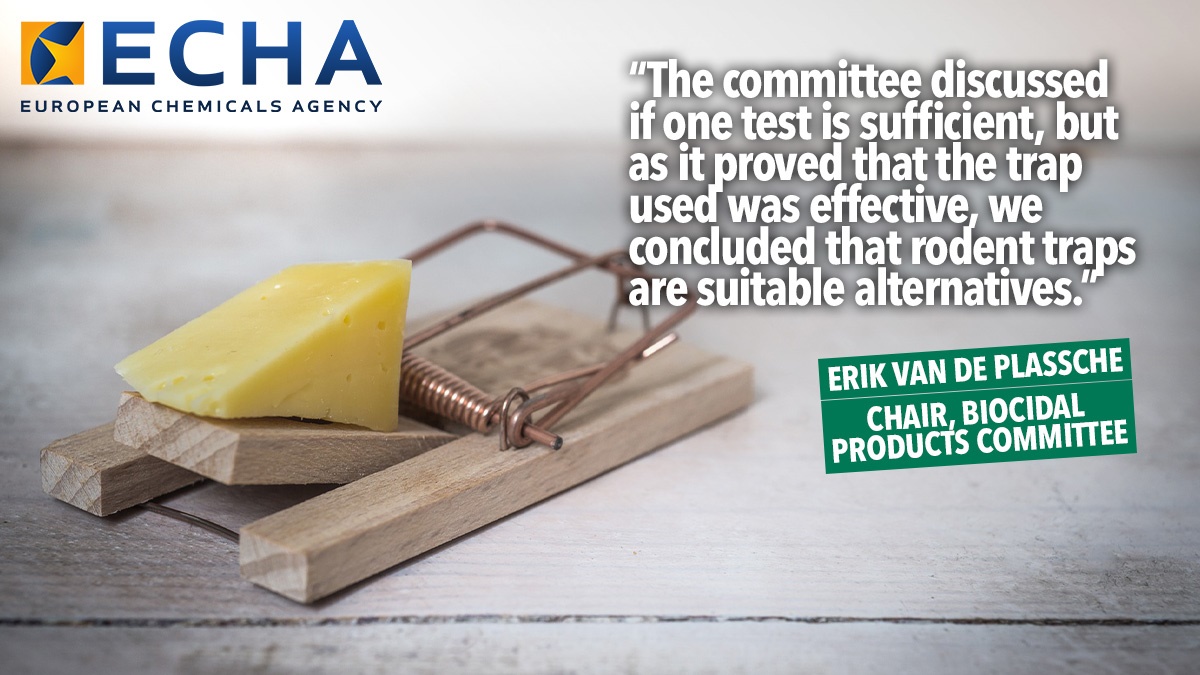
Anticoagulant rodenticides are authorised on the understanding that no other practicable alternatives exist. This statement from ECHA indicates that, in their opinion, mechanical traps can replace anticoagulants for the control of mice.
BPCA has significant concerns with this position and is writing to ECHA to explain this is not the experience of our members controlling mice.
Post-Brexit, UK chemical registrations are handled by the Health and Safety Executive (HSE). However, to date, HSE has remained closely aligned with ECHA.
ECHA said in a statement:
“In its November meeting, the Biocidal Products Committee (BPC) adopted its opinion on the comparative assessment for the second renewal of all anticoagulant or anti-vitamin K (AVK) rodenticides in the EU.
This assessment, which looked at chemical and non-chemical alternatives to anticoagulants, was done by ECHA at the request of the European Commission.
“In summary, the opinion is the following:
“Non-chemical alternatives:
- Mechanical traps used by the general public and (trained) professionals to control house mice indoors are considered effective.
- Use of these traps in this setting does not present significant practical and economical disadvantages and will result in a significantly lower risk for human and animal health and for the environment compared to anticoagulant rodenticides.
- It was recommended to obtain more information to confirm the conclusion, as the available test did not consider different infestation situations (for example, types of building, types of traps and levels of infestation).
- The BPC could not conclude on whether mechanical traps are effective for permanent baiting.
“Chemical alternatives:
- Cholecalciferol and alphachloralose were considered suitable for controlling house mice and for permanent baiting indoors when done by professional users.
- The BPC could not conclude that cholecalciferol and alphachloralose have a significantly better hazard profile for human health, animal health and the environment compared to the anticoagulant rodenticides.
- Carbon dioxide was considered suitable for mice control by trained professionals for permanent baiting indoors. It has a significantly lower overall hazard profile and risk compared to anticoagulant rodenticides”.
Erik van de Plassche, Chair of the BPC, said in an episode of the Safer Chemicals podcast:
“For the use and effectiveness of rodent traps for indoor control of mice, we had one test available. This test was carried out according to existing EU guidance.
“The committee discussed if one test is sufficient, but as it proved that the trap used was effective, we concluded that rodent traps are suitable alternatives.”
BPCA’s concerns
BPCA firmly believe that one test is insufficient to declare that mice infestations can be controlled in every situation without chemical controls.
BPCA will continue to advocate for a well-rounded toolkit available to pest professionals. Without an array of tools, it’ll only put citizens’ health, safety and wellbeing further at risk.
Dee Ward-Thompson, BPCA Head of Technical
Dee Ward-Thompson, Head of Technical at BPCA, said:
“It’s very odd that ECHA would put such a sweeping position statement off the back of a single study.
“Speaking to members, we know that traps aren’t suitable to replace rodenticides in every situation, particularly in urban areas.
“Mechanical traps are an important tool in our kit bags and should be considered as part of an Integrated Pest Management (IPM) approach.
“However, mice infestations can be challenging to treat, and the public health risks are very high.
“We do not consider mechanical traps a total replacement for chemical controls, and we’ll be writing to ECHA to make our position known.”
She continued:
“While the UK is no longer in the EU, chemical regulation remains closely aligned with the union.
“Plus, our HSE will undoubtedly be looking closely at ECHA’s statement.
“Any decisions on this matter in the UK will be made by the Health and Safety Executive, and BPCA will continue to try and influence their decisions.
“BPCA will continue to advocate for a well-rounded toolkit available to pest professionals. Without an array of tools, it’ll only put citizens’ health, safety and wellbeing further at risk”.
ECHA’s next steps
The opinion of the BPC will be sent to the European Commission, which will prepare its decision based on the opinion.
The Commission’s decision is expected to recommend to the Member States how to proceed with the product authorisations for anticoagulant rodenticides. The next comparative assessment is expected in five years.

Source: Online