OPINION | PPC102 MARCH 2021
With increasing regularity we see the misuse of rodent glue boards slammed in the press and social media; with very good reason in many cases.
Chris Cagienard, director and field biologist for BPCA member company Pest Solutions, asks, “in light of glue boards being stuck in the press, should we defend their use?”
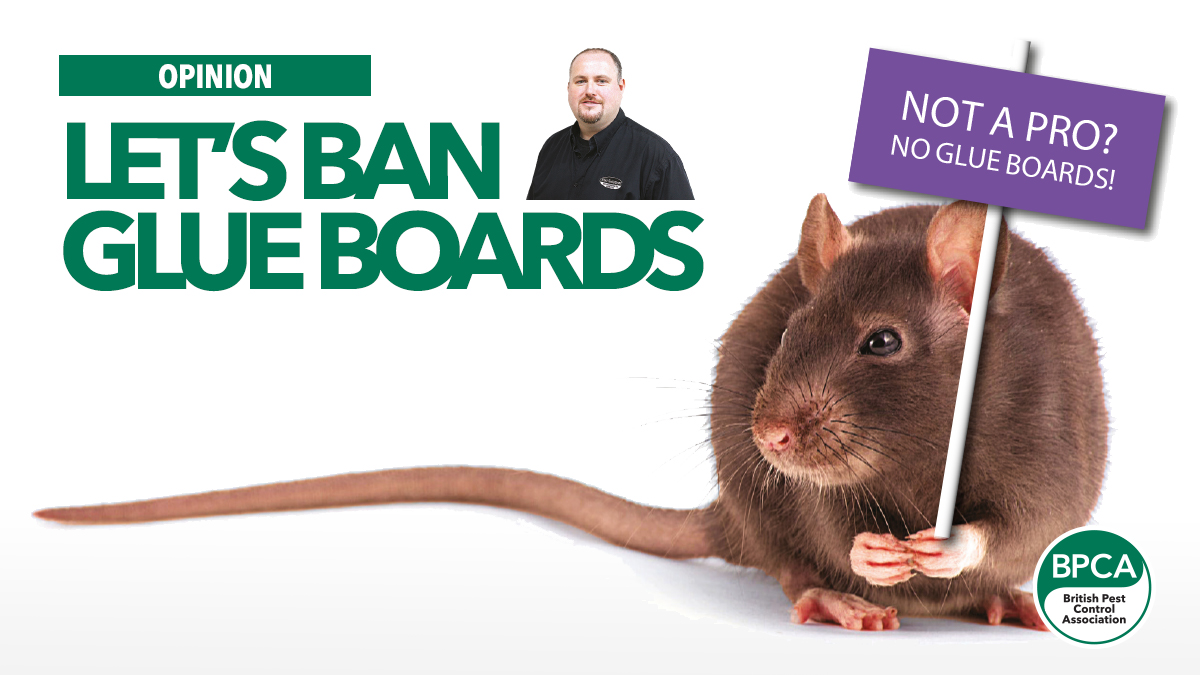
Animal welfare groups are readily campaigning for the outright ban of these products and their method of control.
In almost all their examples of abhorrent misuse by members of the public and ‘would-be professionals’, I find myself ready to stand shoulder-to-shoulder with them in my disgust at the inhumane images presented.
In December 2020, a particularly graphic news article was shared by the RSPCA regarding a cat that had to be put to sleep after becoming stuck on a rat sticky board.
It is unclear if this resulted from improper use of the boards or a poor attempt to dispose of them in a bin that became open.
I don’t think we should rush to blindly defend the use of glue boards; we should ask the hard questions about how we can make this stop.
I support a ban on sale and use of rodent glue boards!
That is, I support a ban to all members of the public and to anyone who cannot demonstrate competency and work practices that fall within a framework that leads to the minimum impact to rodent welfare.
Is this possible? I think it is.
Perception of professionalism
In over 20 years of working in the pest control industry, and having performed glue board treatments to protect public health, I’ve never observed any instances of the horrific scenes shared on social media or in the press.
When a glue board treatment is carried out professionally, in line with good training and following the PMA Code of Best Practice, the target pest’s suffering is significantly reduced.
However, there remains an impact on the welfare of the target pest and a degree of suffering that we should not take lightly. It should concern us.
However, this should be assessed considering the risks to public health and the effectiveness of alternative methods of control or prevention.
As professionals, we need to work hard to distance ourselves from the practices of those who misuse glue boards. We must not only give the perception of professionalism, but we also need to think about how we prove that professionalism.
I have never seen an example of professional use in line with the proper training and procedures challenged as inappropriate. I have only seen examples of horrific misuse portrayed as the norm.
Are we making sure that we’re perceived as professional in our use of glue boards?
Proof of professionalism
How can we prove our professionalism in the use of this control method?
I think BPCA members should be leaders in promoting the humane use of glue boards. We should be the champions of challenging the cases of misuse.
It’s time we took the fight to the wilfully careless and appallingly inhumane individuals that are misusing our toolkit to cause frightening levels of suffering to animals.
We need to demonstrate the difference as we are being judged as the same.
Many of the challengers to the use of glue boards think we’re happy to use this product the way they perceive it from the shocking pictures that they see. They think we are defending these practices when the truth is far from that.
We need to bring reform to the industry in this area, and progress is already being made. The BPCA working group for the Humane Use of Glue Boards is moving quickly to evaluate the options for a training qualification that should be required to buy or use glue boards.
In my opinion this is a significant first step, but I would also like there to be an additional requirement to be a member of a recognised CPD scheme such as BPCA Registered or Basis Prompt.
With the potential for approaching legislators with a robust method of proving competency, we can support a ban on all non-professional users of this product and hopefully see a reduction to the shocking animal welfare issue that their misuse presents.
Opinion on the opinion?
Do you agree or disagree with Chris’s thoughts on the humane use of rodent glue boards? Write to the editor with your opinion, and we might print it here.
Alternatively, have you considered getting involved in one of the BPCA working groups or committees? Register your interest today.
[email protected]
Source: PPC102