PRESS RELEASE
A national trade body is calling on poultry farmers and other bird keepers to step up rat and mouse management as part of measures to halt the spread of Avian flu.
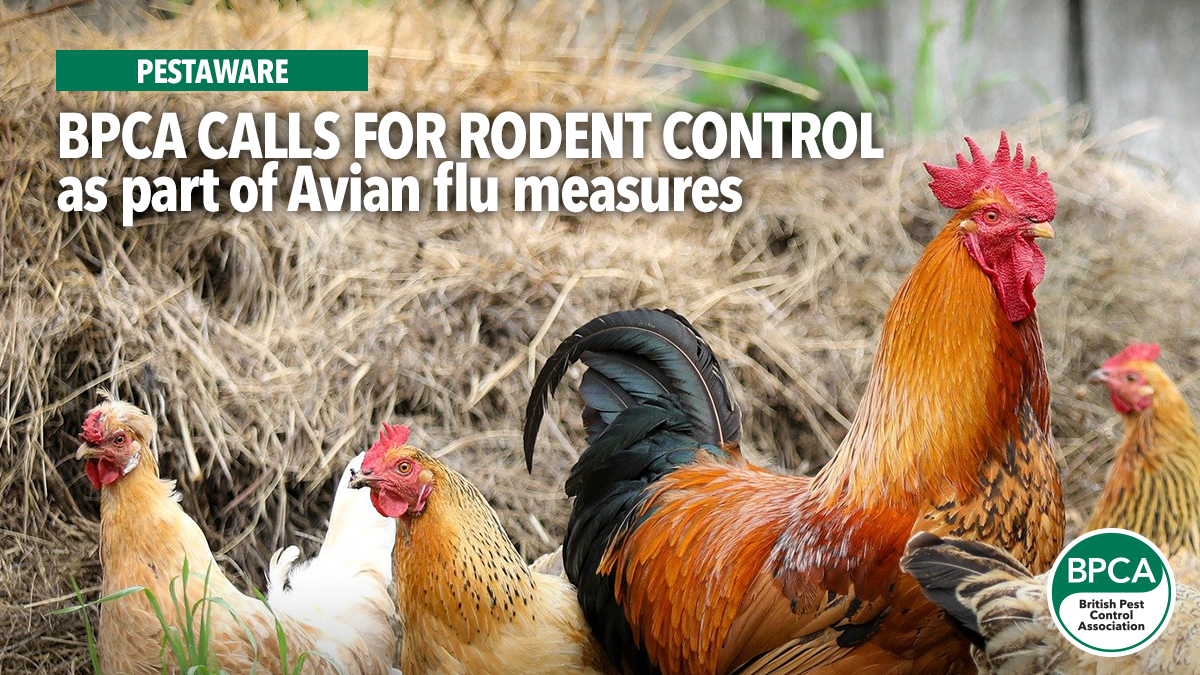
An Avian Influenza Prevention Zone (AIPZ) was declared across England, Scotland and Wales on Thursday, November 12 after outbreaks of a highly pathological strain seen in Russia and Kazakhstan were reported in the UK.
British Pest Control Association (BPCA) is now urging bird keepers to seek professional advice on controlling rodents as part of biosecurity measures to halt the spread of the disease.
Poultry farms and other bird keepers must introduce disinfection measures for people and vehicles and take steps to prevent their flocks mixing with wild birds under the AIPZ.
BPCA is calling for rodent control to also be a priority to help stem the spread of the disease which has been confirmed at farms in Cheshire and Herefordshire.
Dee Ward-Thompson, Technical Manager at BPCA said: “Rats and mice are a common pest issue for poultry farmers and bird keepers.
“Research indicates they may also be vectors in spreading Avian Flu, which is why we are urging bird keepers to prioritise rodent management as part of their biosecurity measures.
“For any rat infestation, we would always recommend contacting a professional pest management company, a member of BPCA.
“They are trained in rat control and will have access to a range of professional use rodenticides and tools, which are not available to the public.
“Professional pest controllers will take an integrated pest management (IPM) approach to tackling your infestation.
“A pest professional will have access to monitoring equipment, which they will use to confirm entry points into your property, the size of the infestation and to track the rat to its nest.
“They can then recommend a proofing strategy and decide on the best course of action in terms of control; this could be traps, rodenticides or a combination of both.”
The current strain of Avian flu does not pose a high risk to the public or food safety and is not connected with Covid-19.
Birds with the disease may suffer from a swollen head, blue discolouration of the neck and throat, loss of appetite, respiratory issues such as gaping beak, coughing and gurgling, diarrhoea, fewer eggs laid and increased mortality.
BPCA members are trained, qualified and audited to the British Standard in Pest Management BS EN 16636.
For more information about pest problems, or to find a professional company, visit bpca.org.uk/find

Source: Online