CHEMICAL REGULATION
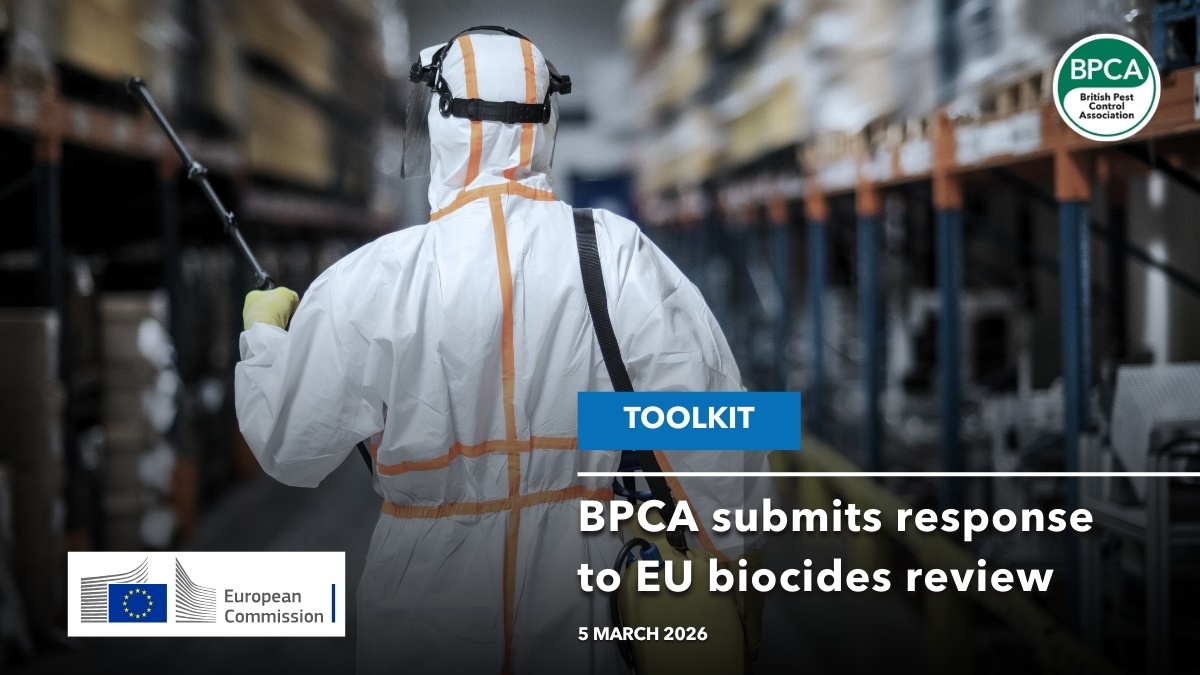
BPCA has submitted a response to the European Commission’s consultation on the EU Biocidal Products Regulation (BPR) Refit, setting out what needs to change to keep public health pest control effective, affordable and innovation-friendly.
Even though the UK has left the EU, BPR decisions still matter for pest management businesses here, including in Northern Ireland, and for manufacturers and distributors who supply products across Europe.
Why do we still take part in European consultations
European rules shape the biocides market we rely on. If authorisations are delayed, inconsistent, or overly burdensome, the knock-on effects can be felt in the UK through:
- Product availability and continuity for professional users
- Higher costs and administrative burden for suppliers, which can feed through to end users
- Slower innovation, including improvements that support integrated pest management (IPM) and resistance management
- Trade friction and fragmentation, which can limit options for compliant products and drive uneven standards.
In short, if the system that approves and maintains biocides is slow, unclear or inconsistent, it becomes harder for pest professionals to do the job properly.
BPCA’s Chief Executive, Rosina Robson, said:
“We’re asking for a system that’s clear, consistent and works within predictable timeframes.
If the goalposts move mid-process and decisions vary between countries, the costs go up, innovation slows down, and product availability becomes less certain.That’s bad for responsible pest management and, ultimately, bad for public health.
Rosina Robson, BPCA Chief Executive
What BPCA said in the response
BPCA backed a regulatory framework that protects people, animals and the environment, while being more predictable and proportionate for businesses, including SMEs.
Our response focused on three practical priorities.
1) Cut uncertainty and wasted cost
We highlighted that shifting requirements, unclear timelines and fragmented decision-making are major cost drivers across the supply chain.
BPCA called for:
- Assessments based on the rules in place at dossier submission
- Stronger data-sharing and reuse to reduce duplicated work and testing
- Realistic risk mitigation that works in the field, not just on paper
- Better harmonisation to reduce divergent decisions between Member States.
2) Speed up time to market
Lengthy evaluation and authorisation timelines reduce return on investment and can discourage companies from supporting active substances and products. We recommended a more risk-based approach, including:
- Prioritising evaluation capacity where risks are emerging, or innovation is genuine
- Trigger-based re-evaluation, so completed work is not repeatedly reopened without new evidence
- Clearer performance metrics and accountability so businesses can plan.
3) Build a stronger pathway for innovation
We stressed that innovation is not only about new active substances. Regulation should also support better formulations, delivery systems, and approaches that reduce exposure and strengthen IPM. BPCA recommended:
- Protecting regulatory capacity for innovation
- Clearer, earlier guidance for novel approaches
- Enabling authorisations that reflect real-world pest pressures and resistance management, rather than assessing substances in isolation.
LOBBYING FOR INNOVATIVE CHEMICAL REGULATION
BPCA is the UK’s only registered lobbying organisation focused entirely on public health pest management. We want chemical regulation to encourage innovation within the sector and protect public health and safety.
You can learn more about our work at:
bpca.org.uk/policy

Source: