RESEARCH
Jon Blount is Professor of Animal Ecophysiology at the Centre for Ecology and Conservation, at the University of Exeter’s Penryn Campus in Cornwall.
It's one of the UK’s largest research groups that specialises in the study of animal ecology, behaviour, evolution and conservation science.
He's looking for help with a research project. Here he explains what it is and how pest controllers can get involved.
Plastic pollution: the low-down
Plastic pollution is a huge issue of global concern. For example, up to 12 million tonnes of plastic debris enters the world’s oceans each year.
Harm to animals arising from direct interactions with plastic debris (e.g. ingestion, entanglement) can be readily observed.
However, plastic pollution can also result in pervasive, sub-lethal impacts caused by exposure to chemical additives found in plastics, such as plasticisers, flame retardants and UV stabilisers.
Such chemical additives enhance the functionality and lifespan of plastic products, but can readily leach into the environment, enter the food chain, and build up in animal’s tissues.
For example, phthalates are plasticisers found in a wide range of everyday plastic items, and also paints, inks and cosmetics.
Phthalates have been called ‘everywhere chemicals’, because they are now present in every corner of the world (even the high Arctic) in soil, water, ice, and air, and in foods and drinking water.
This is concerning, because phthalates can have a range of harmful effects on humans and animals alike, for example by interfering with the body’s hormones, reproduction and development.
Current research
Our research has discovered that Herring Gull eggs contain a diverse ‘cocktail’ of phthalates. However, the specific types of contaminants and their concentrations vary considerably amongst nests.
Phthalates find their way into the adult gull's diet and end up being deposited by mothers into their eggs, and then transferred to developing chicks.
...phthalates are plasticisers found in a wide range of everyday plastic items, and also paints, inks and cosmetics.
Jon Blount
Our main focus currently is to understand how phthalates enter the gull’s diet, and how reproductive success is impacted. We monitor nests at a breeding colony in Cornwall.
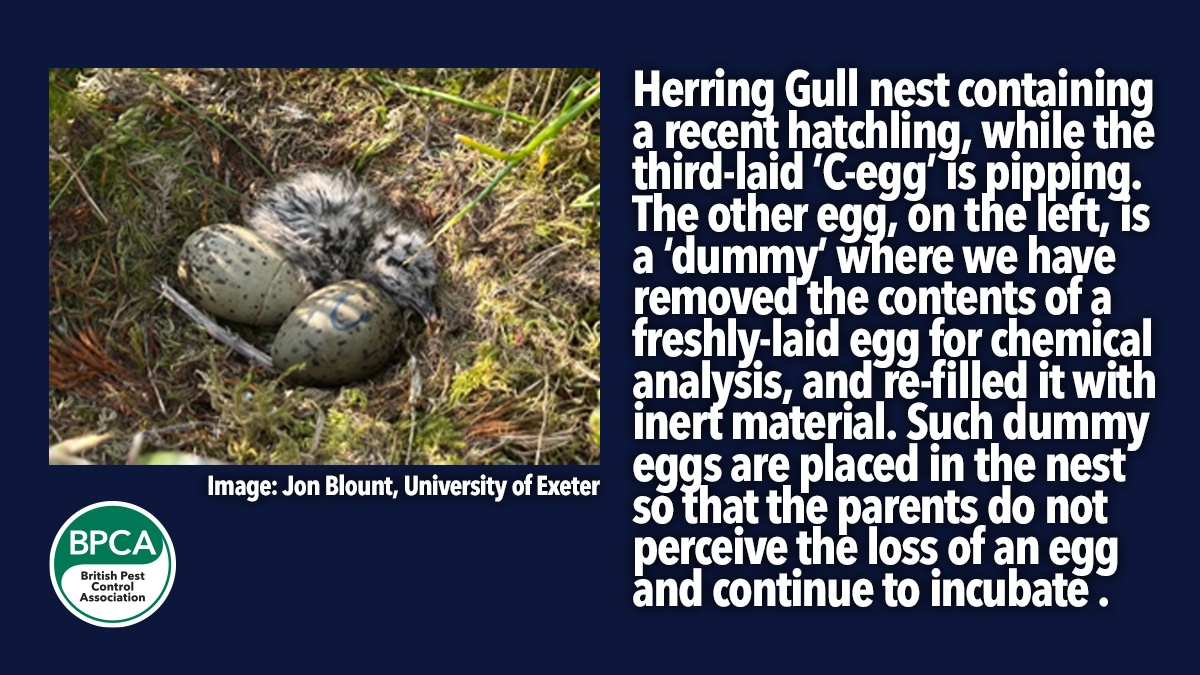
By taking one egg per breeding pair for chemical analysis, we can relate egg phthalate levels to the development, health and survival of the other offspring (image below).
How can you help?
We are keen to extend this work by exploring how phthalate levels in Herring Gull eggs vary across the UK, and in relation to urbanisation, land use, and proximity to the coast among other factors.
We will also use forensic techniques to determine the mother’s foraging preferences (marine, terrestrial, human food sources) inferred from the composition of the eggs that she laid.
We are seeking to link with pest control contractors across the whole of the UK, so we can use Herring Gull eggs that have been collected under Natural England license in 2025 and 2026 for the purposes of pest control, in order to further our understanding of the routes of exposure to plastic additives in wild birds.
Participants will be sent a pre-paid parcel, so they can easily post eggs to our research lab in Cornwall.
Please email me to find out more about the study and to discuss getting involved.
j.d.blount@exeter.ac.uk

Source: Online