Involving pest controllers, farmers, gamekeepers, the rodenticide supply chain and stakeholders, the regime is charged with reducing rodenticide residues in non-target wildlife. The first ever UK Rodenticide Stewardship annual report has been published and marks "the end of the beginning", according to Campaign for Responsible Rodenticide Use (CRRU) chairman Dr Alan Buckle.
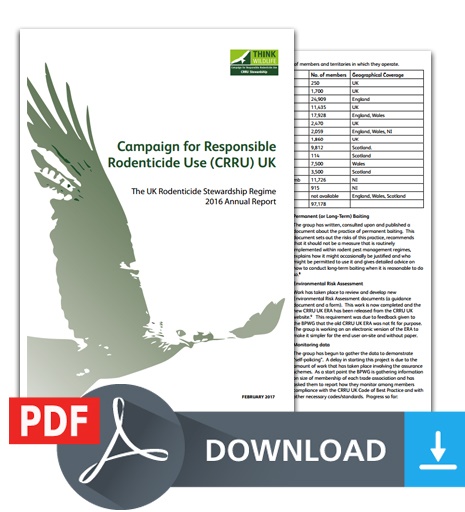 Selected highlights from the 2016 annual report include:
- Publications: Code of best practice for rodent pest management; detailed guidance on permanent baiting; updated environmental risk assessment guidelines with client service pro-forma.
- Proof of competence: Audit of certifications/qualifications; review of farm assurance schemes for equivalence to certification of competence.
- Product regulation: Orderly and timely transition from old scheme to new one based on ‘stewardship conditions' product labels.
- Point of sale: Procedures to check purchaser competence at outlets supplying professional rodenticide products for use outdoors.
- Surveys: In addition to August 2015 KAP, baseline of rodenticide residues in barn owl livers, and breeding parameters in selected owl populations.
- Communication: Sequence of information disseminated to all rodenticide user sectors.
Full report
Dr Buckle says there is considerable work ahead for all three professional sectors of rodenticide users, whose total commitment to the cause is critical for stewardship's success.
"The regime provides a robust system to control rodenticide availability and develop universal and permanent responsible use," he says. "The report identifies significant work carried out so far, and emphasises that much remains to be done. Clearly, the regime is in its early stages.
"If stewardship achieves it purpose, with compelling evidence that professional rodenticides can be used without unacceptable effects on the environment, the products will remain available for our use. Otherwise, we must anticipate further restrictions on where rodenticides can be used and by whom."
As a pre-stewardship benchmark, a Knowledge, Attitude and Practice (KAP) survey was conducted independently in August 2015. This will be repeated periodically as a key element of the regime's monitoring process, in conjunction with data on secondary poisoning, point-of-sale monitoring, training uptake, user competence and rodenticide resistance.
 Scott Johnstone
Communications Officer
16 February 2017 | BPCA.org.uk

Source: BPCA.org.uk